In lithium-ion battery manufacturing, slot-die coating is one of the most critical processes for producing high-quality electrodes with excellent thickness uniformity. However, even a slight deviation in coating conditions can lead to significant edge defects.
Among these defects, Heavy Edge and Light Edge are two of the most common and troublesome issues. They not only reduce production yield but can also affect calendering performance, winding stability, and ultimately battery safety and cycle life.
This article summarizes the root causes of these edge defects, practical optimization methods, and real manufacturing experiences from production engineers.
What Is Heavy Edge?
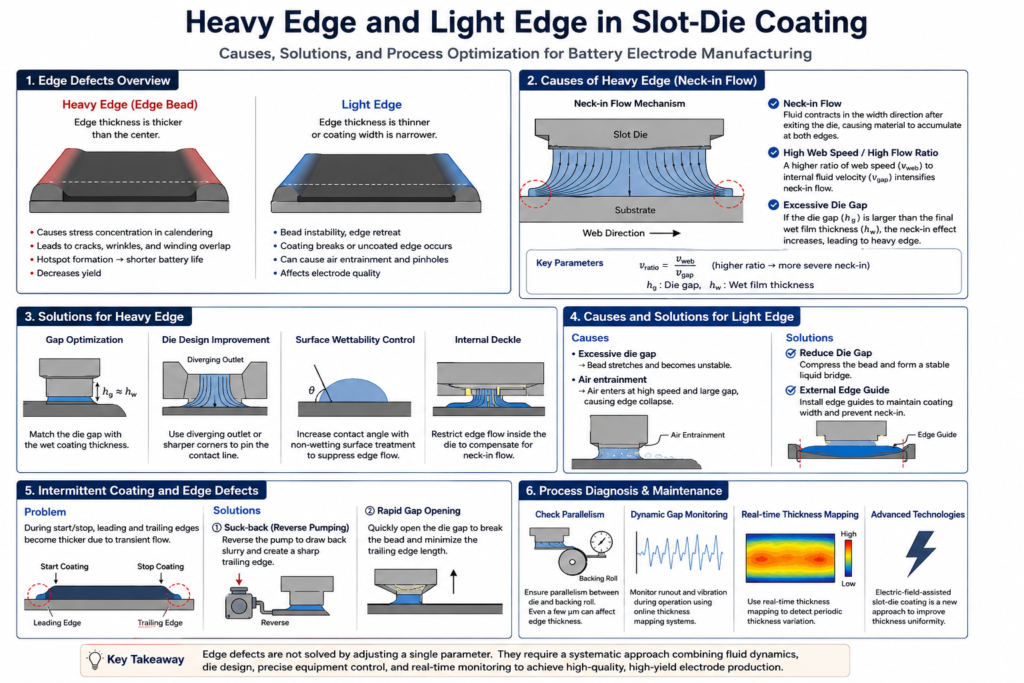
Heavy Edge refers to a condition where the coating thickness near both edges of the electrode is significantly greater than that in the center. It is also commonly called Edge Bead or Edge Elevation.
Although the defect may appear minor during coating, it often creates serious downstream problems, including:
- Stress concentration during calendering
- Electrode edge cracking and wrinkling
- Winding overlap and mechanical damage
- Localized hotspot formation inside battery cells
- Reduced production yield and shorter battery life
From my perspective, Heavy Edge is rarely an isolated coating issue. In most manufacturing lines, it usually indicates that the entire coating system—including fluid dynamics, machine alignment, and process parameters—is approaching its stability limit.
Why Does Heavy Edge Occur?
1. Neck-in Flow
The primary cause is neck-in flow.
As slurry exits the slot die and lands on the moving current collector, the liquid naturally contracts toward the center because of surface tension and flow dynamics.
Since mass must be conserved, additional slurry accumulates near both edges, creating thicker edge regions.
2. Web Speed and Die Gap Ratio
Heavy Edge becomes more severe when the ratio between web speed and internal slurry velocity increases.
A larger die-to-substrate gap also allows greater contraction before the slurry reaches the substrate, amplifying the edge bead.
How to Reduce Heavy Edge
Several proven engineering approaches can effectively minimize Heavy Edge.
Optimize the Die Gap
One of the simplest yet most effective methods is matching the die gap to the target wet coating thickness.
An excessively large gap gives the slurry more time to contract before deposition.
Improve Die Geometry
Researchers have shown that modifying the slot-die outlet geometry—such as using a diverging outlet or sharper die corners—helps stabilize the contact line and suppress edge bead formation.
Control Surface Wettability
Applying non-wetting surface treatments increases the contact angle between slurry and die surface, reducing excessive edge flow.
Use Internal Deckles
Internal deckles reduce slurry flow near the edges before coating begins, compensating for neck-in effects and producing a more uniform thickness profile.
What Is Light Edge?
Light Edge is the opposite phenomenon.
Instead of thicker edges, the coating becomes thinner or the coating width narrows near the edges.
Typical causes include:
- Excessive die gap
- Bead instability
- Air entrainment at high coating speeds
When the coating bead stretches excessively, the liquid curtain becomes unstable and the edge coating may collapse.
Solutions for Light Edge
Stabilize the Coating Bead
Reducing the die gap compresses the coating bead and forms a more stable liquid bridge between the die lip and substrate.
External Edge Guides
Some manufacturers install external edge guides to physically maintain coating width and suppress neck-in during high-speed coating.
Edge Defects in Intermittent Coating
Battery electrodes often require intermittent coating to create uncoated tabs.
Unlike continuous coating, intermittent coating introduces transient flow behavior at the leading and trailing edges.
The trailing edge is especially difficult because slurry continues flowing briefly after pump shutdown due to:
- Residual pressure
- Slurry elasticity
- Flow inertia
This creates elongated and thicker trailing edges.
Practical Solutions
Manufacturers commonly use:
- Suck-back control, where the pump briefly reverses to retract slurry into the slot die.
- Rapid die-gap opening, which intentionally breaks the coating bead at shutdown.
These techniques significantly improve edge sharpness and reduce coating defects.
Process Diagnosis and Preventive Maintenance
Even with optimized coating parameters, equipment condition plays a major role.
Engineers should routinely verify:
- Slot die and backing roll parallelism
- Dynamic die-gap variation during production
- Roll runout and bearing vibration
- Online thickness mapping across the coating width
Recent studies have also demonstrated that applying an electric field to the slot-die coating process may improve transverse flow uniformity and reduce thickness variation.
Practical Case 1: Heavy Edge Solved by Gap Optimization
A production engineer observed recurring edge cracks after calendering despite acceptable average coating thickness.
The root cause was an oversized die gap that promoted neck-in flow.
After reducing the gap closer to the target wet thickness, Heavy Edge decreased significantly, edge cracking disappeared, and production yield improved without changing slurry composition.
This case highlights that mechanical settings often have a greater impact than material changes.
Practical Case 2: Light Edge Caused by Equipment Misalignment
Another manufacturing line experienced unstable coating width only at high production speeds.
Initial troubleshooting focused on slurry viscosity, but the actual problem was slight non-parallel alignment between the slot die and backing roll.
Although the misalignment measured only a few micrometers, correcting the die alignment restored coating stability and eliminated the Light Edge defect.
This serves as a reminder that precision equipment alignment is just as important as slurry formulation.
My Perspective
In my opinion, many engineers spend too much time adjusting slurry formulations when edge defects appear.
While slurry rheology is certainly important, most recurring Heavy Edge and Light Edge problems originate from the interaction of fluid dynamics, machine geometry, die gap, web speed, and equipment stability.
Successful battery manufacturers rarely solve these defects by changing a single parameter. Instead, they optimize the coating system as a whole.
As coating speeds continue increasing for next-generation EV batteries, systematic process optimization will become even more critical for maintaining both production efficiency and battery quality.
Conclusion
Heavy Edge and Light Edge are far more than cosmetic coating imperfections. They directly influence calendering performance, winding quality, cell safety, and long-term battery reliability.
The most effective solution is a comprehensive approach that combines fluid mechanics, optimized slot-die design, precise equipment alignment, dynamic process control, and continuous monitoring rather than relying on a single process adjustment.
References
- Lee, H., Kim, J., & Kwon, O. (2022). Investigation of Edge Bead Formation in Slot-Die Coating for Lithium-Ion Battery Electrodes. Journal of Coatings Technology and Research.
- Carvalho, M. S., & Kheshgi, H. S. (2000). Low-Flow Limit in Slot Coating: Theory and Experiment. AIChE Journal, 46(10), 1907–1917.
- Meyerhofer, D. (1978). Characteristics of Resist Films Produced by Spin Coating. Journal of Applied Physics, 49(7), 3993–3997.
- Romero, O. J., & Suszynski, W. J. (2004). Slot Coating of Thin Liquid Films. Chemical Engineering and Processing, 43(6), 729–738.
- Lee, J., & Scriven, L. E. (2002). Hydrodynamic Model of Slot-Die Coating Flows. Journal of Fluid Mechanics.
- Schabel, W., Scharfer, P., & Kind, M. (2004). Drying of Battery Electrodes: Fundamentals and Process Engineering. Drying Technology.
- Gutoff, E. B., & Cohen, E. D. (2016). Coating and Drying Defects: Troubleshooting Operating Problems (3rd Edition). Wiley.
- Kistler, S. F., & Schweizer, P. M. (1997). Liquid Film Coating: Scientific Principles and Their Technological Implications. Chapman & Hall.
- Weinstein, S. J., & Ruschak, K. J. (2004). Coating Flows. Annual Review of Fluid Mechanics, 36, 29–53.
- Park, J., et al. (2023). Effect of Surface Wettability on Edge Bead Suppression in Slot-Die Coating of Battery Electrodes. Journal of Energy Storage.
- LG Energy Solution. Electrode Manufacturing Technology for Lithium-Ion Batteries. Technical Publication.
- Samsung SDI. Advanced Electrode Coating Process for High-Energy-Density Batteries. Technical White Paper.
- Hwang, J., et al. (2021). Optimization of Slot-Die Coating Parameters for Uniform Lithium-Ion Battery Electrodes. Journal of Power Sources, 482.
- DuPont. Slot-Die Coating Technology Guide. Technical Bulletin.
- FMP Technology GmbH. Slot Die Coating Handbook. Technical Manual.
- Yasuda, K., et al. (2020). Edge Flow Control in High-Speed Slot-Die Coating Using External Edge Guides. Surface Coatings International.
- Toyota Central R&D Labs. Intermittent Slot-Die Coating Technology for Lithium-Ion Battery Electrodes. Technical Report.
- Kim, S., et al. (2022). Transient Flow Behavior During Intermittent Slot-Die Coating. Journal of Manufacturing Processes.
- Hwang, H., et al. (2021). Analysis of Trailing Edge Formation in Intermittent Slot Coating. Chemical Engineering Science.
- Nordson Precision Dispensing. Precision Slot Die Systems for Intermittent Coating Applications. Application Note.
- Coatomer Co., Ltd. Advanced Slot Die Coating Solutions for Lithium-Ion Batteries. Technical Catalog.
- Hitachi High-Tech. Precision Alignment Technologies for Electrode Coating Systems. Technical Paper.
- Honeywell Process Solutions. Online Thickness Measurement for Battery Electrode Manufacturing. White Paper.
- Beta LaserMike. Continuous Thickness Monitoring Systems for Coating Applications. Technical Guide.
- Wang, Y., et al. (2024). Electric-Field-Assisted Slot-Die Coating for Enhanced Thickness Uniformity of Lithium-Ion Battery Electrodes. ACS Applied Materials & Interfaces.
- Zhang, L., et al. (2024). Improving Coating Uniformity via Electrohydrodynamic Control in Slot-Die Coating. Advanced Functional Materials.
- Wood, D. L., Li, J., & Daniel, C. (2015). Prospects for Reducing the Processing Cost of Lithium-Ion Batteries. Journal of Power Sources, 275, 234–242.