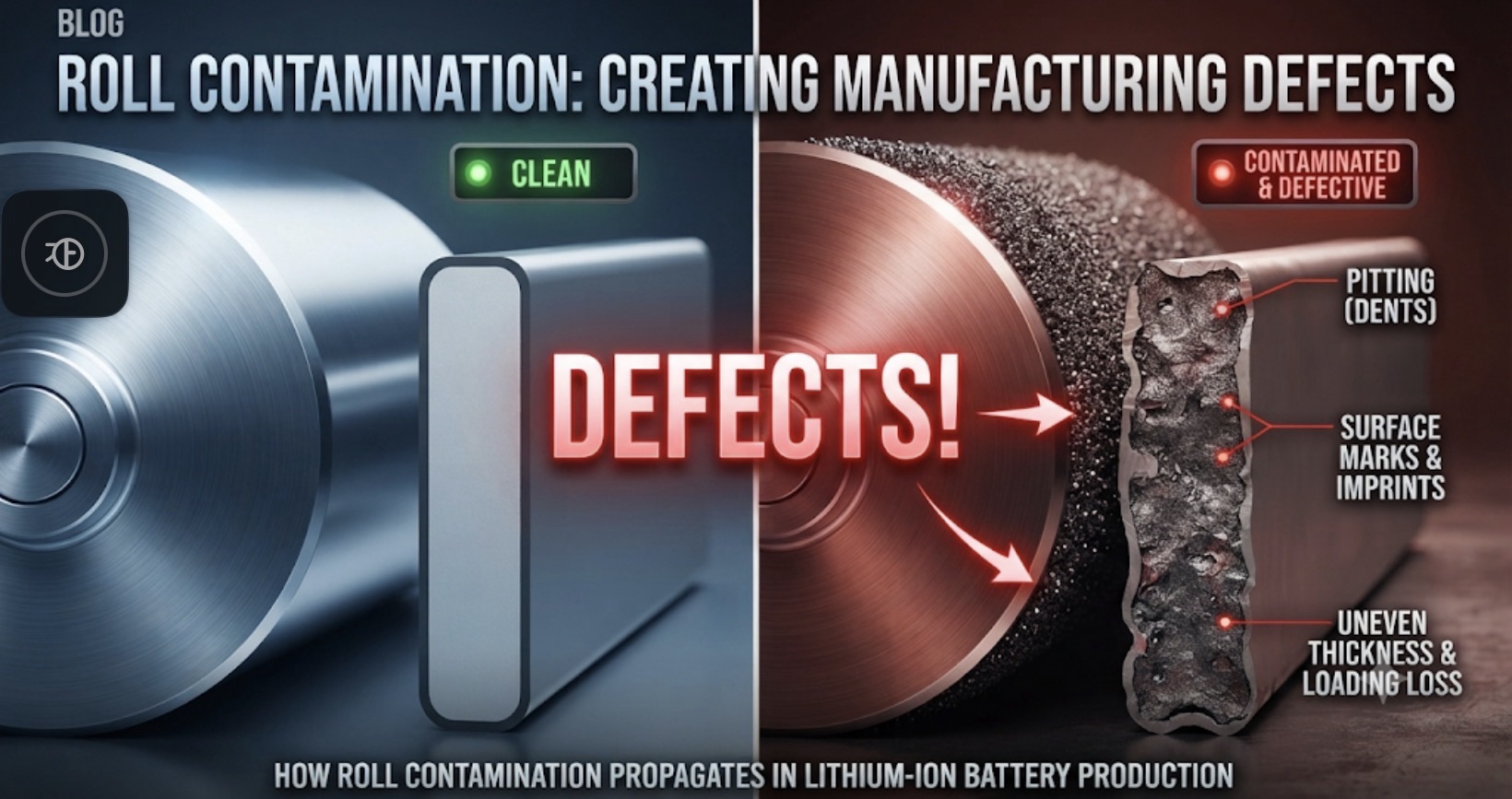
This is Part 2A of the series: Why Roll Contamination During Battery Electrode Calendering Matters.
In Part 1, we explored why roll contamination occurs during the calendering process and why it has become an increasingly important issue as lithium-ion batteries move toward higher energy density and larger-scale production.
However, contamination itself is only the beginning of the problem.
The real concern is how even a microscopic amount of contamination can propagate throughout an entire production line, creating thousands of defective electrodes before operators detect the issue.
Unlike obvious machine failures, roll contamination often develops gradually. The first few meters of electrode may appear perfectly acceptable, while contamination continues accumulating on the roll surface. By the time visible defects appear, large volumes of production may already be affected.
For this reason, leading battery manufacturers classify roll cleanliness as a critical process parameter rather than a routine maintenance task.
Why Small Contaminants Can Become Large Manufacturing Problems
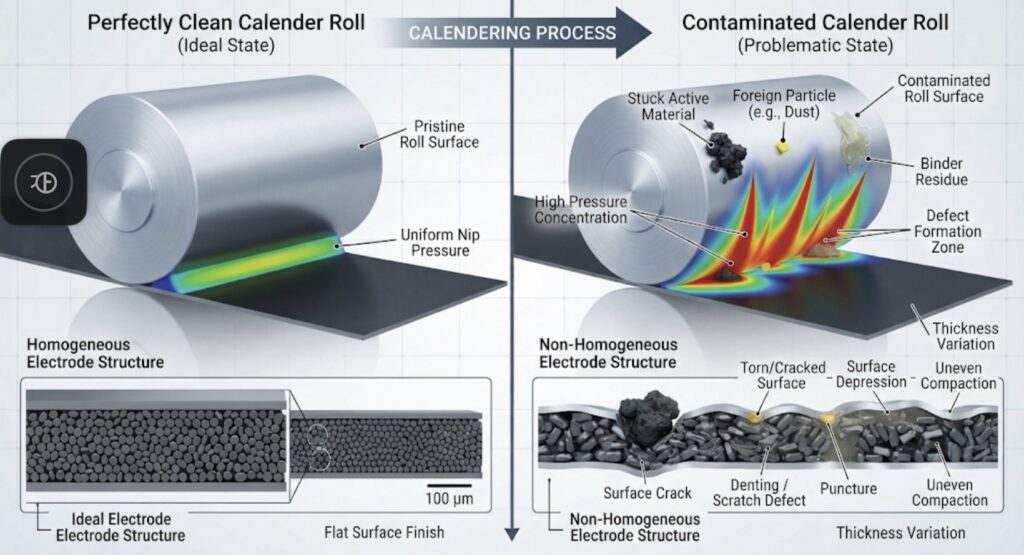
Calender rolls are designed to deliver uniform pressure across every millimeter of the electrode.
When the roll surface is perfectly smooth, pressure distribution remains consistent, producing electrodes with uniform thickness, density, and surface quality.
Once contamination attaches to the roll, this balance changes immediately.
Instead of compressing the electrode evenly, the contaminated area creates localized pressure variations.
These variations may only measure a few micrometers, but lithium-ion battery manufacturing operates within extremely tight tolerances. Even microscopic inconsistencies can influence electrochemical performance after cell assembly.
The contaminated material is then transferred repeatedly onto every electrode passing through the machine, turning one small contamination point into a continuous production defect.
Pitting: One of the Most Common Surface Defects
Among all defects associated with roll contamination, pitting is one of the most frequently observed.
Pitting appears as tiny dents or circular marks on the electrode surface after calendering.
Although these defects may seem insignificant, they indicate that abnormal pressure was applied during compression.
The root cause is often a particle trapped between the roll and the electrode.
Instead of producing uniform compression, the particle concentrates pressure into a single point, permanently deforming the coating.
As production continues, the same contaminant can create repeating pit patterns along hundreds of meters of electrode.
In severe cases, pitting may reduce local coating integrity and increase the probability of internal defects during cell assembly.
Surface Marks and Roll Imprinting
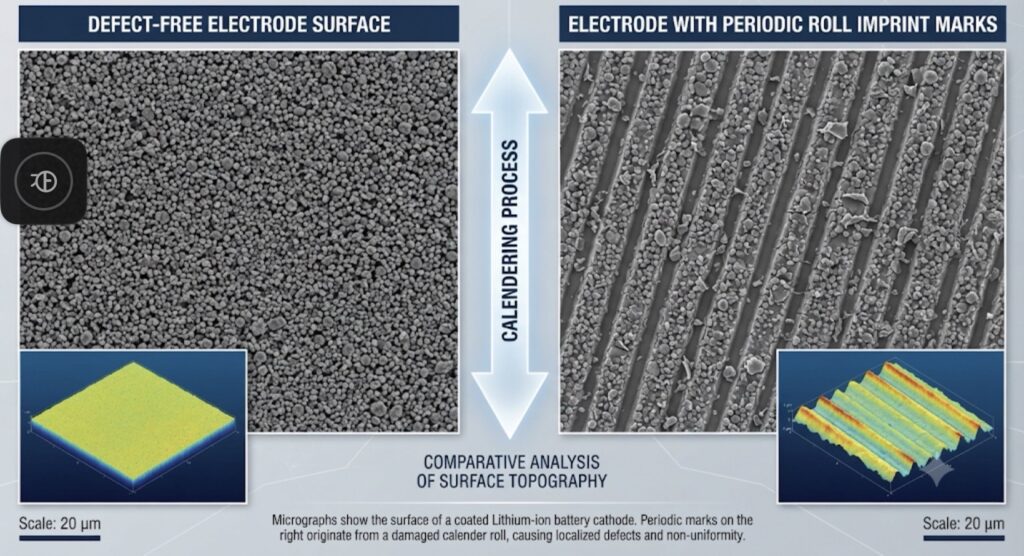
Another common issue is the appearance of repetitive surface marks.
When active material accumulates on the roll surface, it effectively changes the geometry of the roll itself.
Rather than transferring a perfectly smooth finish, the roll begins imprinting contamination patterns directly onto the electrode.
These repeating marks often become valuable diagnostic indicators because their spacing corresponds to the roll circumference.
Engineers frequently use this repeating pattern to identify whether defects originate from:
- contaminated rolls,
- damaged roll surfaces,
- embedded foreign particles,
- or mechanical runout.
Although surface marks may initially appear cosmetic, they often indicate much deeper process instability.
Loading Loss: Losing Active Material During Calendering
One of the most expensive consequences of roll contamination is loading loss.
During normal calendering, the active material should remain firmly attached to the current collector.
However, contaminated rolls can pull portions of the coating away from the electrode.
Instead of compressing the coating, the contaminated area behaves almost like adhesive tape.
Each rotation removes tiny amounts of active material.
Although each individual loss is microscopic, continuous production magnifies the problem.
Reduced active material loading means:
- lower battery capacity,
- reduced energy density,
- increased cell-to-cell variation,
- lower manufacturing yield.
Since modern electric vehicle batteries require extremely consistent capacity across thousands of cells, even minor loading loss becomes economically significant.
Delamination: Weakening Electrode Integrity
Roll contamination can also contribute to electrode delamination.
Delamination occurs when the bond between the active material layer and the current collector weakens.
Several contamination-related mechanisms contribute to this problem.
If contamination prevents uniform compression, binder distribution becomes uneven.
Some regions receive adequate compression, while others remain insufficiently compacted.
During repeated charge-discharge cycling, these weaker regions experience higher mechanical stress.
Over time, microscopic separation may begin developing between the coating and the metal foil.
Although delamination usually originates from multiple process variables, contaminated calender rolls can significantly increase the probability of failure.
Thickness Variation and Density Inconsistency
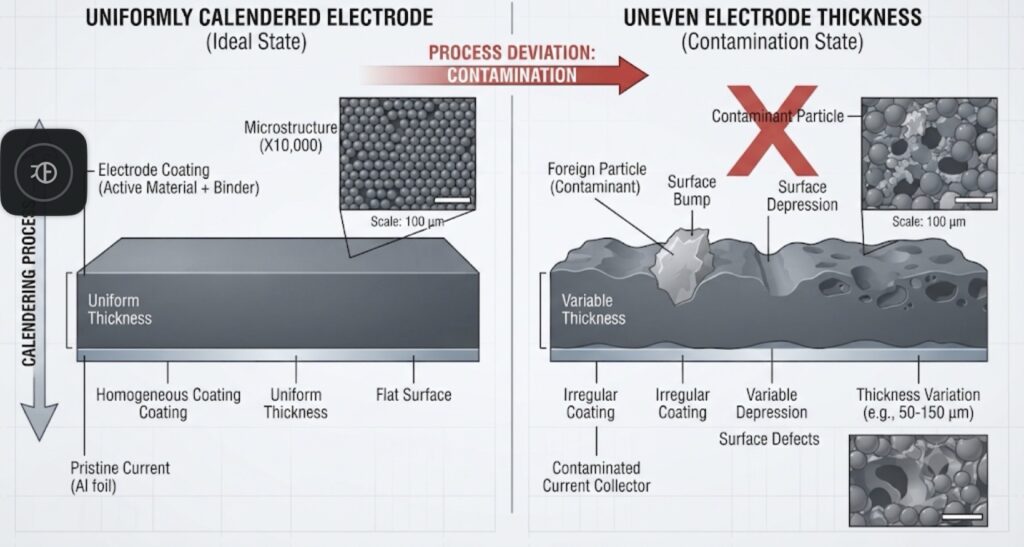
Modern lithium-ion batteries require remarkably tight manufacturing tolerances.
Electrode thickness is often controlled within only a few micrometers.
Roll contamination disrupts this precision.
Material attached to the roll effectively changes the compression gap.
Some regions receive greater compression while others receive less.
The result is non-uniform electrode density.
These density variations influence several electrochemical characteristics, including:
- lithium-ion transport,
- electrode porosity,
- electrolyte penetration,
- mechanical stability,
- cycle life.
As battery energy density continues increasing, manufacturers have less tolerance for these variations than ever before.
Increased Internal Resistance
The purpose of calendering is not simply to flatten the electrode.
Proper compression improves contact between active material particles, conductive additives, and the current collector.
This creates efficient electrical pathways throughout the electrode.
When contamination interferes with compression, these conductive pathways become less effective.
Poor particle contact increases electrical resistance.
Higher resistance generates more heat during charging and discharging.
For electric vehicle batteries operating under high power conditions, excessive resistance may reduce efficiency and accelerate long-term degradation.
Production Downtime: The Hidden Cost
Perhaps the greatest financial impact of roll contamination is not the defective electrode itself.
It is the production interruption required to remove contamination.
Whenever contamination reaches unacceptable levels, manufacturers may need to:
- stop the production line,
- inspect the roll surface,
- clean accumulated material,
- verify roll condition,
- recalibrate equipment,
- restart production.
Each shutdown reduces overall equipment effectiveness (OEE).
In gigafactories producing millions of battery cells annually, even short interruptions translate into substantial production losses.
This is why many manufacturers now prefer preventive cleaning rather than waiting for visible contamination to appear.
Preventive maintenance minimizes both defect rates and unexpected downtime.
Why Traditional Cleaning Is No Longer Enough
Historically, many battery plants relied on manual wiping using cleaning cloths and solvent.
While this approach was acceptable for lower production volumes, today’s gigafactories operate at much higher speeds and much tighter quality standards.
Manual cleaning presents several limitations:
- It requires production to stop.
- Cleaning quality depends on operator consistency.
- Microscopic contaminants often remain on the roll.
- Cleaning intervals may be too long for modern production speeds.
- Repeatability is difficult to maintain.
As battery manufacturing becomes increasingly automated, manufacturers are moving toward intelligent cleaning systems capable of maintaining roll cleanliness without compromising productivity.
These advanced technologies—including automatic cleaning modules, mechanical scraper systems, water-based cleaning solutions, and laser cleaning—will be explored in the next section.
Key Takeaways
Roll contamination is far more than a housekeeping issue.
It directly affects electrode quality, production efficiency, and ultimately battery performance.
The most common manufacturing problems include:
- Pitting defects
- Surface imprint marks
- Active material loading loss
- Electrode delamination
- Thickness variation
- Increased internal resistance
- Lower production yield
- Equipment downtime
Understanding these failure mechanisms is the first step toward implementing effective contamination control strategies.
Industry Insight: What Causes Roll Contamination in Practice
The first is binder Tg (glass transition temperature) being too high — this makes the electrode surface too hard and brittle, which can lead to flaking or particle transfer onto the calendering rolls. The opposite problem occurs when Tg is too low: the binder stays too soft, making the electrode surface prone to sticking and smearing during roll contact.
The third scenario, and one that’s easy to miss if you’re only looking at bulk formulation, involves binder migration during electrode drying. As the solvent evaporates, binder can migrate toward the top surface of the electrode rather than staying evenly distributed through the coating layer. This creates a binder-rich, high-tackiness surface layer — even if the overall binder content in the formulation looks correct on paper, this localized surface effect can still cause the electrode to stick to the rolls.
This is a good reminder that roll contamination often isn’t a single-cause problem — it can come from the binder chemistry itself, or from how the drying process redistributes that binder within the electrode.