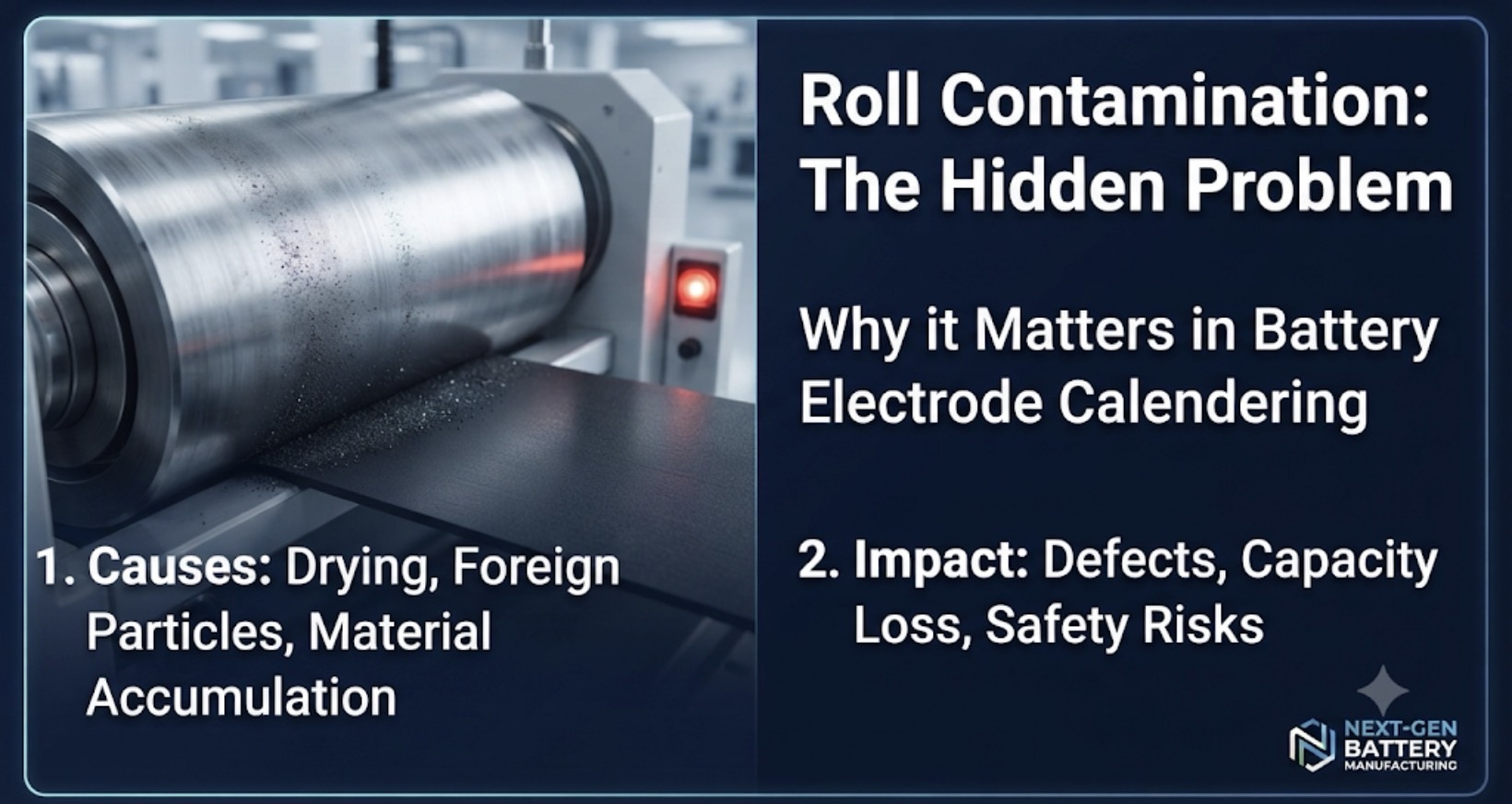
Roll contamination is one of the most overlooked problems in lithium-ion battery manufacturing. Learn why roll contamination occurs during electrode calendering, how it affects battery performance, and the latest cleaning technologies used in modern battery production.
Why Roll Contamination During Battery Electrode Calendering Matters
When people think about lithium-ion battery performance, they usually focus on battery chemistry, silicon anodes, high-nickel cathodes, or next-generation solid-state batteries.
However, one of the biggest factors affecting battery quality is much less visible.
It happens inside the manufacturing line.
One small defect created during electrode production can eventually reduce battery capacity, shorten cycle life, increase internal resistance, or even create safety risks.
Among the numerous manufacturing challenges, roll contamination during the calendering process is one of the most underestimated.
Although it may appear to be a simple maintenance issue, contamination on calender rolls directly affects electrode thickness, density, coating integrity, and surface quality.
As battery manufacturers continue pursuing higher energy density and faster production speeds, controlling roll cleanliness has become increasingly important.
In this article, we’ll explore why roll contamination occurs, how it impacts battery performance, and why advanced cleaning technologies are becoming essential in next-generation battery factories.
Understanding the Electrode Calendering Process
Before discussing contamination, it’s important to understand the role of calendering.
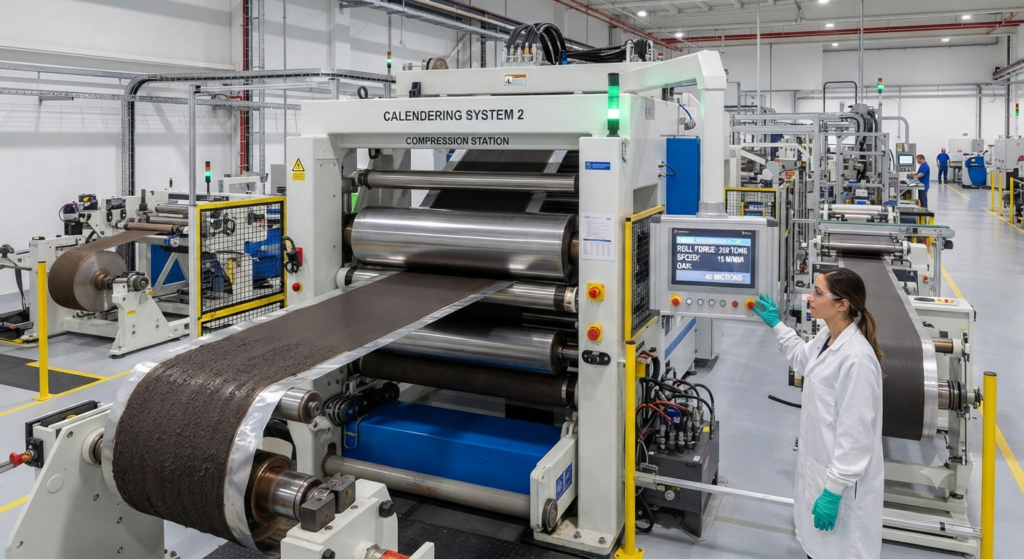
After electrode slurry has been coated and dried, the electrode passes through two precisely machined steel rolls.
These rolls compress the electrode under carefully controlled pressure.
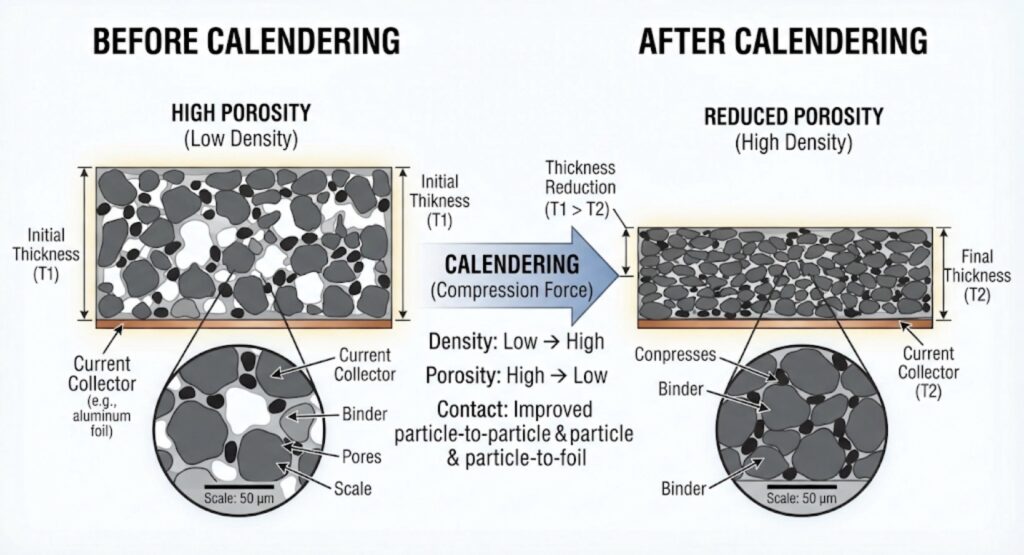
Although this sounds simple, calendering determines several critical properties of the finished electrode.
The process helps:
- Increase electrode density
- Improve particle-to-particle contact
- Reduce internal resistance
- Enhance adhesion between active material and current collector
- Improve energy density
- Create a smoother electrode surface
- Control final electrode thickness
Every battery manufacturer carefully optimizes calendering pressure, roll temperature, and line speed because even small deviations can influence battery performance.
Unfortunately, these same operating conditions also make contamination more likely.
Why Roll Contamination Has Become a Bigger Problem
Ten years ago, roll contamination was considered a routine maintenance issue.
Today, it has become a major manufacturing challenge.
Several industry trends are responsible.
1. Finer Active Materials
Modern batteries increasingly use extremely fine powders.
These particles offer higher electrochemical performance and enable greater energy density.
However, smaller particles also have larger surface areas and stronger adhesion forces.
Instead of passing smoothly through the calender rolls, some particles remain attached to the roll surface.
As production continues, these particles accumulate layer by layer until contamination becomes significant.
2. Higher Conductive Additive Loading
Advanced batteries designed for electric vehicles require improved electrical conductivity.
Manufacturers therefore increase the amount of conductive carbon materials.
These conductive additives are extremely lightweight and easily adhere to polished metal surfaces.
Over time, they mix with binder residues and active material particles, creating stubborn contamination that is difficult to remove using conventional wiping methods.
3. Higher Production Speeds
Gigafactories continue increasing production speed to reduce manufacturing costs.
Modern calender lines operate much faster than previous generations.
While higher speed improves productivity, it also reduces the time available for contaminants to separate naturally from the roll surface.
This accelerates contamination buildup.
4. Larger Electrode Formats
Battery manufacturers now produce increasingly larger electrodes for electric vehicles and energy storage systems.
A larger electrode means:
- longer production runs,
- higher roll loads,
- and greater opportunities for contamination to accumulate.
Without effective cleaning, contamination gradually spreads across wider roll surfaces.
The Four Major Causes of Roll Contamination
Although contamination appears in many forms, most cases originate from four primary sources.
1. Insufficient Electrode Drying
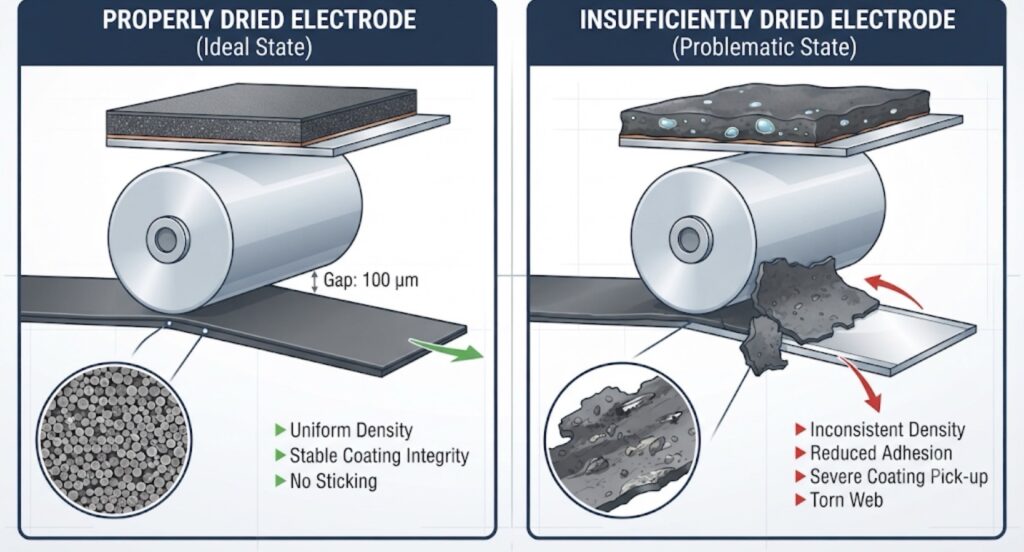
One of the most common causes is incomplete solvent removal.
After coating, electrodes must pass through drying ovens to remove solvent before calendering.
If excessive solvent remains, the coating surface becomes slightly tacky.
Instead of sliding smoothly between the rolls, active material begins sticking to the roll surface.
This phenomenon is commonly known as roller adhesion.
The contaminated material is then transferred repeatedly to subsequent sections of the electrode, creating increasingly severe defects.
Many battery manufacturers therefore maintain strict control of residual solvent levels before calendering.
Proper drying is not simply about energy efficiency—it is one of the first defenses against roll contamination.
2. Foreign Particle Contamination
Another major cause is foreign particles entering the production line.
Possible contamination sources include:
- metal fragments,
- damaged machine components,
- hardened slurry particles,
- dust,
- environmental debris.
When these hard particles become trapped between the electrode and the roll, they scratch or dent the polished roll surface.
Even microscopic scratches dramatically increase the likelihood of additional material becoming trapped during later production.
In many factories, maintaining extremely low roll surface roughness is essential for minimizing contamination.
3. Material Accumulation During Continuous Production
Even under ideal operating conditions, tiny amounts of active material remain on the roll after each electrode passes through.
Initially these deposits are almost invisible.
However, after thousands of meters of continuous production, the accumulated layer becomes thick enough to influence electrode quality.
This explains why many production lines perform scheduled cleaning after fixed production distances rather than waiting until visible contamination appears.
Preventive cleaning is far more effective than corrective cleaning.
4. Electrode Material Formulation
Battery chemistry itself also influences contamination behavior.
Different combinations of:
- binder content,
- conductive additives,
- particle morphology,
- solvent systems,
- moisture content,
can significantly change how easily materials adhere to steel rolls.
For example, modern water-based graphite anodes often require different cleaning approaches compared with traditional solvent-based systems.
As the industry shifts toward environmentally friendly water-based processing, manufacturers must also redesign their cleaning strategies.
Why Even Small Roll Contamination Can Create Big Manufacturing Problems
At first glance, contamination may appear insignificant.
A few particles attached to a steel roll hardly seem capable of affecting battery performance.
In reality, the opposite is true.
Because the calender roll contacts every millimeter of electrode passing through the production line, even microscopic contamination can be transferred continuously across hundreds—or even thousands—of meters of electrode.
A single contaminated spot may eventually generate thousands of defective battery cells before the problem is detected.
For this reason, leading battery manufacturers treat roll cleanliness as a critical process control parameter rather than a simple maintenance task.
In the next section, we’ll examine how roll contamination leads to electrode defects, capacity loss, equipment downtime, and reduced manufacturing yield—and explore the advanced cleaning technologies being adopted to solve these challenges.