Last Updated: July 2026
Disclosure: This article is intended for general educational purposes and reflects publicly available battery science research. It is not professional engineering or investment advice.
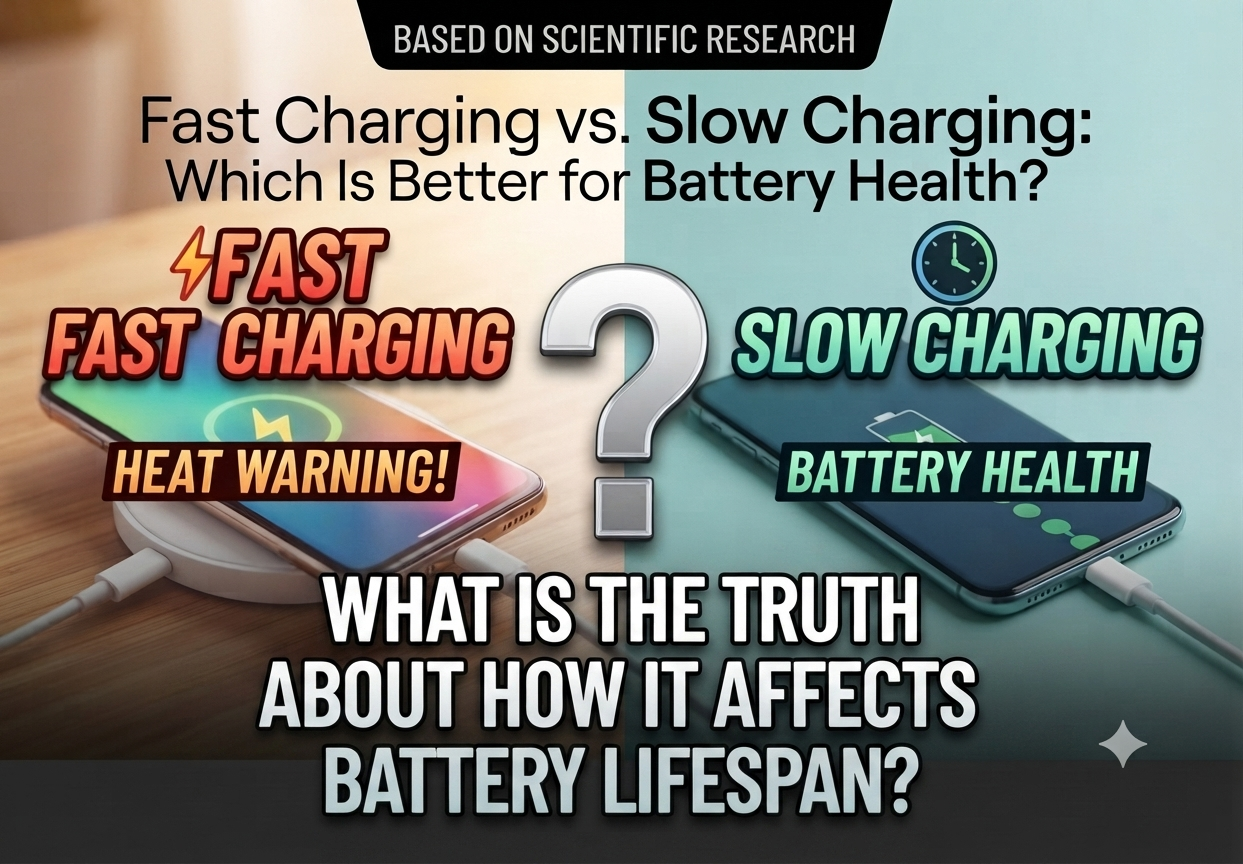
Fast Charging vs. Slow Charging: Which Is Better for Battery Health?
I get this question more than almost any other from friends shopping for an EV: “if I fast charge all the time, am I wrecking the battery?” It’s a fair worry — charging technology has moved fast enough that it’s hard to keep up. Some of today’s ultra-fast chargers can take a car from nearly empty to nearly full in well under 15 minutes, which makes long-distance travel genuinely convenient. But convenience and battery health aren’t automatically the same thing, and the honest answer to “does fast charging damage batteries” is more nuanced than a flat yes or no.
Charging speed does influence temperature, internal chemistry, and long-term degradation — but modern batteries handle that stress far better than the ones from even five years ago. I want to walk through what’s actually happening inside the cell during fast versus slow charging, and how to think about the tradeoff practically.
What Is Fast Charging?
Fast charging delivers a much higher electrical current to the battery, cutting charging time dramatically compared to a standard outlet. Charging Method Typical Power Slow Charging (AC) 3–11 kW Fast Charging (DC) 50–150 kW Ultra-Fast Charging 250–450 kW Next-Gen “Flash” Charging up to 1,000+ kW
Fast charging bypasses the vehicle’s onboard AC charger and feeds direct current (DC) straight into the battery pack, which is what makes it so much quicker. It’s genuinely useful for highway travel and emergency situations — and the ceiling keeps rising. Several manufacturers have now demonstrated charging systems that add real range in under 10 minutes, with the fastest current systems reportedly taking a battery from around 10% to 80% in roughly that same window.
What Is Slow Charging?
Slow charging typically uses alternating current (AC) through a home charger or workplace charging station.
Because the power level is so much lower, the battery generates far less heat and experiences much less electrochemical stress. It takes longer, but in my experience — and in the data — it’s still the healthiest option for everyday charging.
Most EV owners I know charge overnight on AC, letting the battery fill gradually while keeping long-term wear to a minimum.
How Charging Speed Actually Affects Battery Health
The core issue with fast charging is heat and internal stress, not the current itself being inherently dangerous.
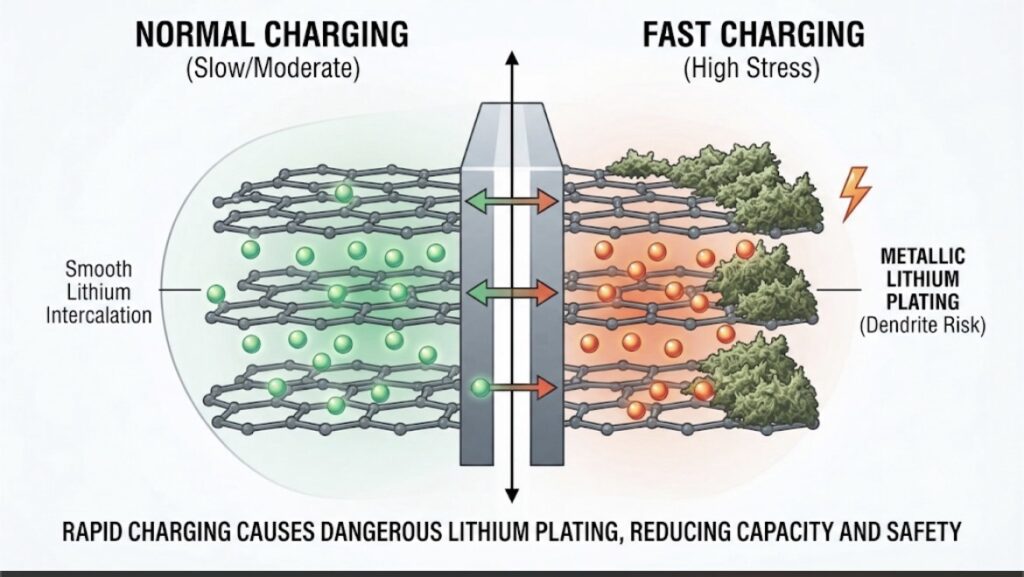
During fast charging, lithium ions move rapidly from the cathode toward the anode. If that movement happens too quickly — especially at a high state of charge or in cold temperatures — some of those ions won’t fully intercalate into the graphite anode. Instead, metallic lithium can deposit directly on the anode surface, a process called lithium plating.
Lithium plating is one of the more consequential failure modes in battery chemistry: it reduces usable capacity, raises internal resistance, and can meaningfully shorten battery life if it happens repeatedly. On top of that, fast charging simply generates more heat overall, and heat accelerates electrolyte decomposition and SEI layer growth — the same degradation pathways that show up in ordinary aging, just sped up.
Why Modern Batteries Handle Fast Charging So Much Better Now
This is the part that’s genuinely changed. Today’s batteries — and the systems around them — are a different generation from what was on the road even five years ago.
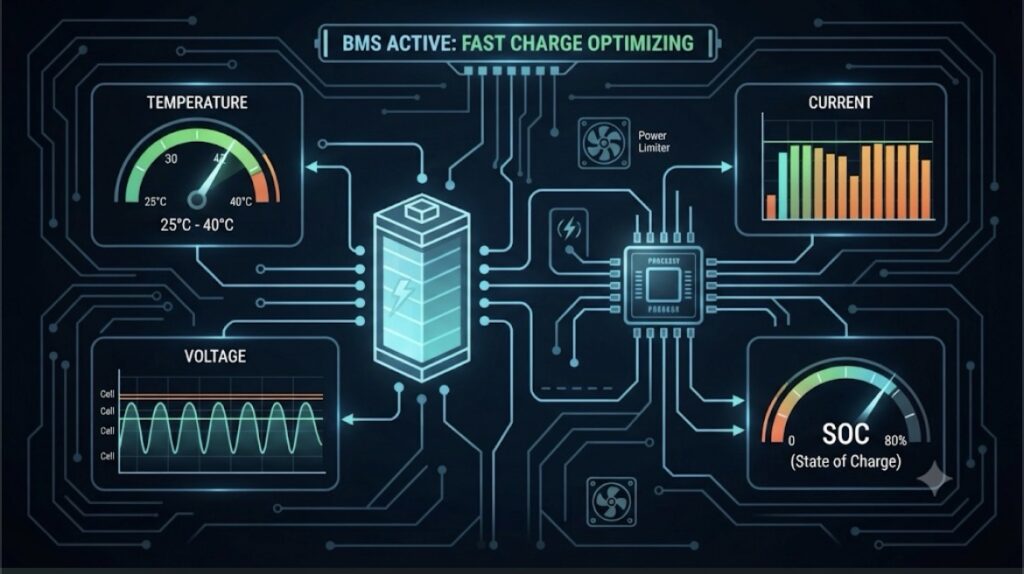
Modern Battery Management Systems (BMS) continuously track:
- Battery temperature
- Voltage
- Charging current
- Cell balance
- State of Charge (SOC)
When conditions call for it, the BMS automatically throttles charging speed to protect the cell. Many EVs now also use active liquid cooling and battery pre-conditioning — warming or cooling the pack before you even arrive at a fast charger — specifically to hold high charging speeds safely for longer. Together, these systems have substantially reduced the risks that used to be associated with fast charging.
When Fast Charging Actually Makes Sense
Fast charging has clear, legitimate uses. It’s especially valuable for:
- Long-distance travel
- Emergency charging
- Commercial fleets
- Ride-sharing vehicles
- Drivers without reliable home charging access
Occasional fast charging has a fairly minimal impact on battery health when it’s backed by a modern BMS and thermal management system. What tends to accelerate degradation is relying on it as your primary, daily charging method rather than an occasional convenience.
Best Practices for Extending Battery Life
Most of the guidance from battery engineers converges on a fairly simple, balanced strategy:
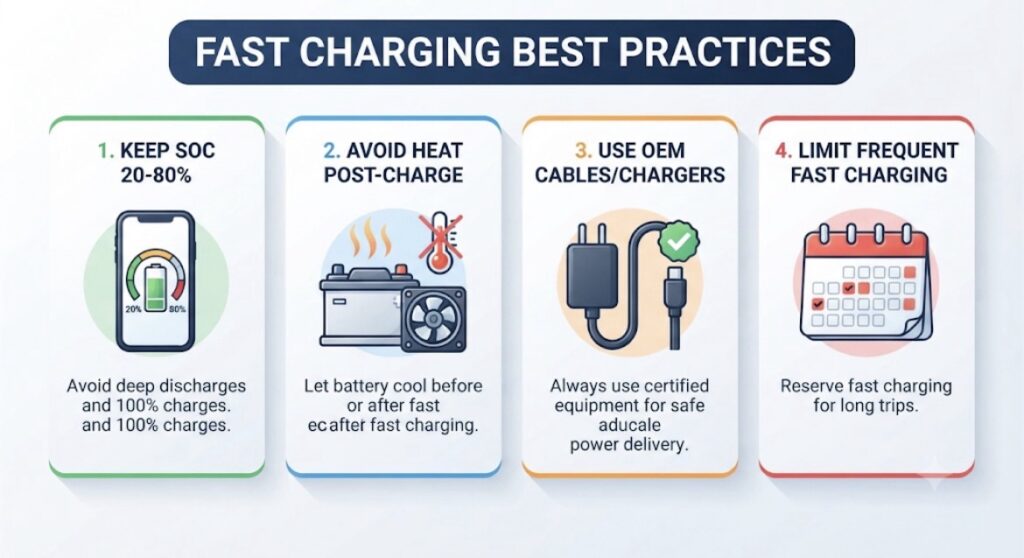
- Use slow AC charging for everyday charging whenever it’s available.
- Save DC fast charging for long trips or genuinely urgent situations.
- Avoid charging to 100% unless you actually need the full range.
- Keep daily charging in roughly the 20–80% range.
- Avoid fast charging immediately after aggressive driving, while the battery is already hot.
- Park in shaded or temperature-controlled spots when you can.
None of these habits eliminate wear entirely, but together they meaningfully reduce the thermal stress that drives long-term capacity loss.
The Future of Fast Charging
This is one of the areas of battery technology moving fastest right now, and it’s worth watching closely if you follow the space the way I do. Several major battery makers have released systems this year built specifically to close the old tradeoff between charging speed and cycle life — silicon-dominant anodes, sodium-ion chemistries, and solid electrolytes are all part of that push, and a handful of announced systems now hold sub-15-minute charge targets while still demonstrating hundreds to thousands of cycles at commercially reasonable degradation rates.
High-voltage, 800V-plus architectures paired with more aggressive thermal management have already pushed real-world charging times well under 15 minutes for some current-generation vehicles, and megawatt-scale “flash charging” systems have moved from demonstration to early deployment. Improvements in battery chemistry and thermal management are what’s making that possible without simply trading speed for a shorter battery life — which used to be the default engineering compromise.
In my opinion
The fast-charging-versus-slow-charging debate tends to generate more anxiety than it deserves. Fast charging itself isn’t inherently harmful — what actually drives accelerated degradation is the combination of high current, elevated temperature, and repeated use under conditions the battery wasn’t well protected against.
Manufacturing quality matters just as much here as it does everywhere else in battery health. A well-built cell with uniform electrode coating, high-quality binders, properly optimized calendering, and strong thermal management tolerates fast charging far better than a poorly manufactured one running the exact same charging profile. For most EV owners, I’d keep it simple: default to slow charging for daily convenience, and treat fast charging as the tool it’s meant to be — there when time actually matters, not a daily habit by default.
Frequently Asked Questions
Does fast charging permanently damage lithium-ion batteries?
Not inherently. Modern batteries are engineered to handle fast charging safely. The risk comes from frequent fast charging combined with high heat over a long period, which can gradually accelerate degradation.
Is slow charging always better?
For daily use, yes. It produces less heat and places less stress on the internal materials, which is why it remains the preferred default for maximizing battery lifespan.
Can I fast charge my EV every day?
You can, and the battery won’t fail because of it — but most manufacturers still recommend AC charging for routine use and reserving DC fast charging for longer trips or occasional need.
Why does charging slow down after 80%?
The BMS intentionally tapers charging speed above roughly 80% to protect the battery from the higher voltage stress and heat that come with topping off a nearly full cell.
Will solid-state batteries solve fast-charging problems?
They’re expected to support meaningfully faster charging with better safety and less degradation, and several manufacturers have already shown early systems built around this approach. Large-scale, mainstream commercialization is still in progress.
Sources
- International Energy Agency (IEA), Ultra-fast charging batteries – Analysis (2026)
- Battery Tech Online, 7 of the Fastest-Charging EV Batteries in 2026
Related Articles
- What Determines Battery Lifespan?
- Battery Degradation Explained
- Why Batteries Swell
- Understanding Battery Thermal Runaway
- LFP vs NCM Batteries: Which Battery Chemistry Lasts Longer?