Artificial intelligence is no longer just driving semiconductor demand—it is fundamentally reshaping how the industry grows. What began as a recovery cycle has evolved into a structural transformation supported by AI infrastructure, advanced packaging, and high-performance memory.
As we enter the third quarter of 2026, investors should stop asking “Will semiconductors recover?” and instead ask “Which semiconductor companies are positioned to benefit from the next AI investment cycle?”
This article explores the three biggest investment themes defining today’s semiconductor market.
The Semiconductor Industry Has Entered a New Era
For decades, semiconductor markets followed predictable boom-and-bust cycles. Memory prices surged during shortages before collapsing once production caught up.
That pattern is changing.
The explosive expansion of AI data centers has created structural demand that extends beyond consumer electronics. Every new AI model requires enormous computing power, high-speed networking, and advanced memory solutions.
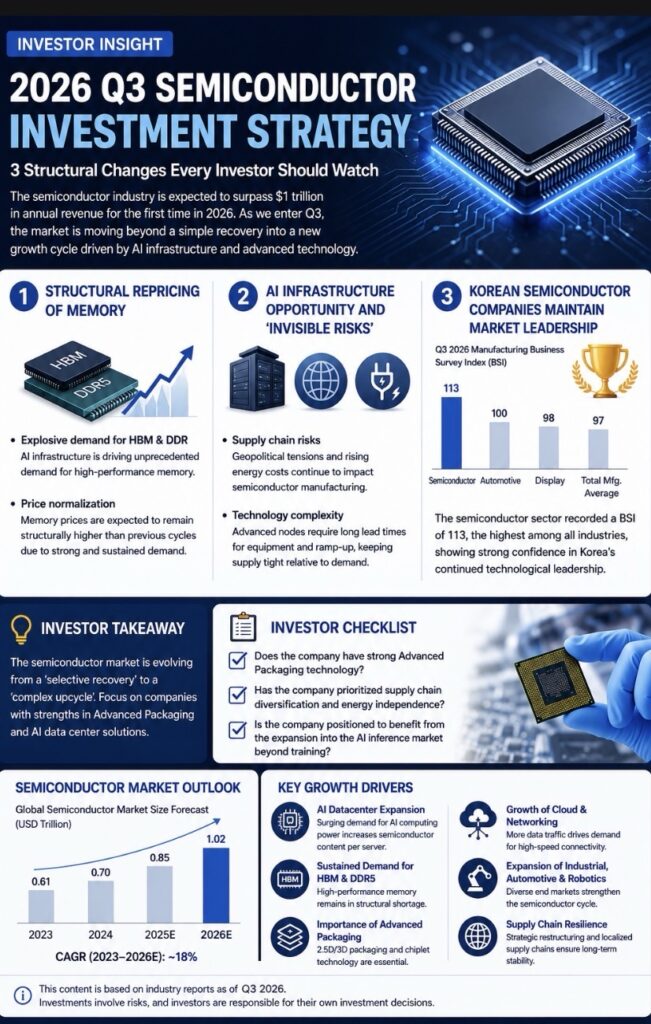
Industry analysts now expect global semiconductor revenue to exceed $1 trillion annually, marking one of the fastest periods of growth in technology history.
Instead of waiting for traditional recovery cycles, investors should focus on where long-term AI spending is flowing.
1. Memory Semiconductors Are Being Structurally Repriced
Perhaps the biggest change in 2026 is occurring inside the memory market.
Rather than competing only on production volume, manufacturers now compete on performance.
Why HBM Matters
High Bandwidth Memory (HBM) has become the critical component inside AI accelerators.
Modern AI GPUs require enormous memory bandwidth to process trillion-parameter language models efficiently.
Major cloud providers are purchasing HBM at premium prices because computing performance—not component cost—has become the priority.
As a result:
- HBM demand continues exceeding supply
- DDR5 adoption keeps accelerating
- Premium memory pricing remains resilient
- Profit margins improve significantly compared with previous cycles
This represents a structural shift rather than a temporary shortage.
2. AI Infrastructure Spending Creates Opportunity—And Risk
AI investment remains the largest growth driver across the semiconductor ecosystem.
However, rapid expansion also introduces new challenges investors should monitor carefully.
Supply Chain Constraints
Advanced semiconductor manufacturing depends on highly specialized equipment, materials, and packaging capacity.
Potential risks include:
- Geopolitical tensions
- Export regulations
- Rising electricity costs
- Water availability
- Advanced packaging bottlenecks
Even if AI demand remains strong, production capacity cannot expand overnight.
This supply imbalance could keep pricing elevated while increasing volatility across semiconductor stocks.
3. Advanced Packaging Is Becoming Just as Important as Chip Design
For years, investors focused mainly on chip designers and foundries.
Today, advanced packaging is emerging as one of the industry’s highest-value technologies.
Instead of simply making faster chips, companies now improve overall AI performance by packaging multiple dies into highly integrated systems.
Technologies such as:
- Chiplet architecture
- 2.5D packaging
- 3D packaging
- CoWoS-type integration
- HBM stacking
are becoming essential for next-generation AI computing.
Companies participating in these areas may experience stronger long-term growth than businesses focused solely on traditional semiconductor manufacturing.
Why Korean Semiconductor Companies Remain Competitive
Despite increasing global competition, Korean semiconductor companies continue demonstrating strong confidence throughout 2026.
Several advantages remain clear:
Competitive Factor
Investment Impact
HBM leadership
Strong pricing power
Advanced DRAM technology
High AI demand
Manufacturing scale
Stable production capability
Continuous R&D investment
Long-term competitiveness
Global customer relationships
Sustainable revenue growth
The AI era rewards technological leadership more than manufacturing scale alone.
Risks Investors Should Not Ignore
Every structural growth story also contains potential risks.
Key factors to monitor include:
- AI spending slowing faster than expected
- Delays in hyperscale data-center investment
- Supply chain disruptions
- Higher interest rates affecting technology valuations
- Geopolitical uncertainty impacting exports
Understanding these risks helps investors build more balanced portfolios rather than relying solely on AI enthusiasm.
My Investment View
The semiconductor industry appears to be transitioning from a cyclical recovery into a multi-year structural expansion.
Instead of investing broadly across every semiconductor company, I believe investors should pay closer attention to businesses with exposure to:
- High Bandwidth Memory (HBM)
- Advanced Packaging
- AI servers
- Data-center infrastructure
- High-performance networking
- Semiconductor manufacturing equipment
These segments are positioned to capture a larger share of future AI investment.
Frequently Asked Questions
Is the semiconductor boom only about AI?
No.
AI is currently the largest growth driver, but automotive electronics, industrial automation, edge computing, robotics, and on-device AI are also expanding semiconductor demand.
Why is Advanced Packaging receiving so much attention?
Modern AI chips are becoming too large and complex for traditional packaging methods.
Advanced packaging enables higher performance, lower power consumption, and greater computing efficiency, making it essential for future AI hardware.
Will memory prices continue rising?
While short-term fluctuations are always possible, structural AI demand suggests memory pricing may remain stronger than during previous semiconductor cycles.
Key Takeaways
✅ AI demand is transforming the semiconductor industry from cyclical growth to structural growth.
✅ High Bandwidth Memory (HBM) continues to be one of the industry’s strongest investment themes.
✅ Advanced Packaging is becoming a core competitive advantage.
✅ Investors should evaluate semiconductor companies based on AI exposure rather than traditional market cycles.
Final Thoughts
The third quarter of 2026 may be remembered as the period when the semiconductor industry fully transitioned into the AI era.
Companies capable of supplying high-performance memory, advanced packaging technologies, and AI infrastructure solutions are likely to remain at the center of this transformation.
For investors, understanding these structural shifts could prove more valuable than simply following short-term market movements.
SEO Keywords
2026 semiconductor outlook, AI semiconductor stocks, HBM memory, advanced packaging, semiconductor investment, AI infrastructure, semiconductor market Q3 2026, DDR5, AI data center, semiconductor industry trends
Disclaimer: This article is intended for informational and educational purposes only and should not be considered investment advice. Always conduct your own research before making investment decisions.