As lithium-ion batteries continue to power electric vehicles, energy storage systems, and consumer electronics, manufacturers are pushing for higher energy density and faster production speeds. While battery materials often receive the most attention, manufacturing processes are equally critical in determining final battery performance and safety.
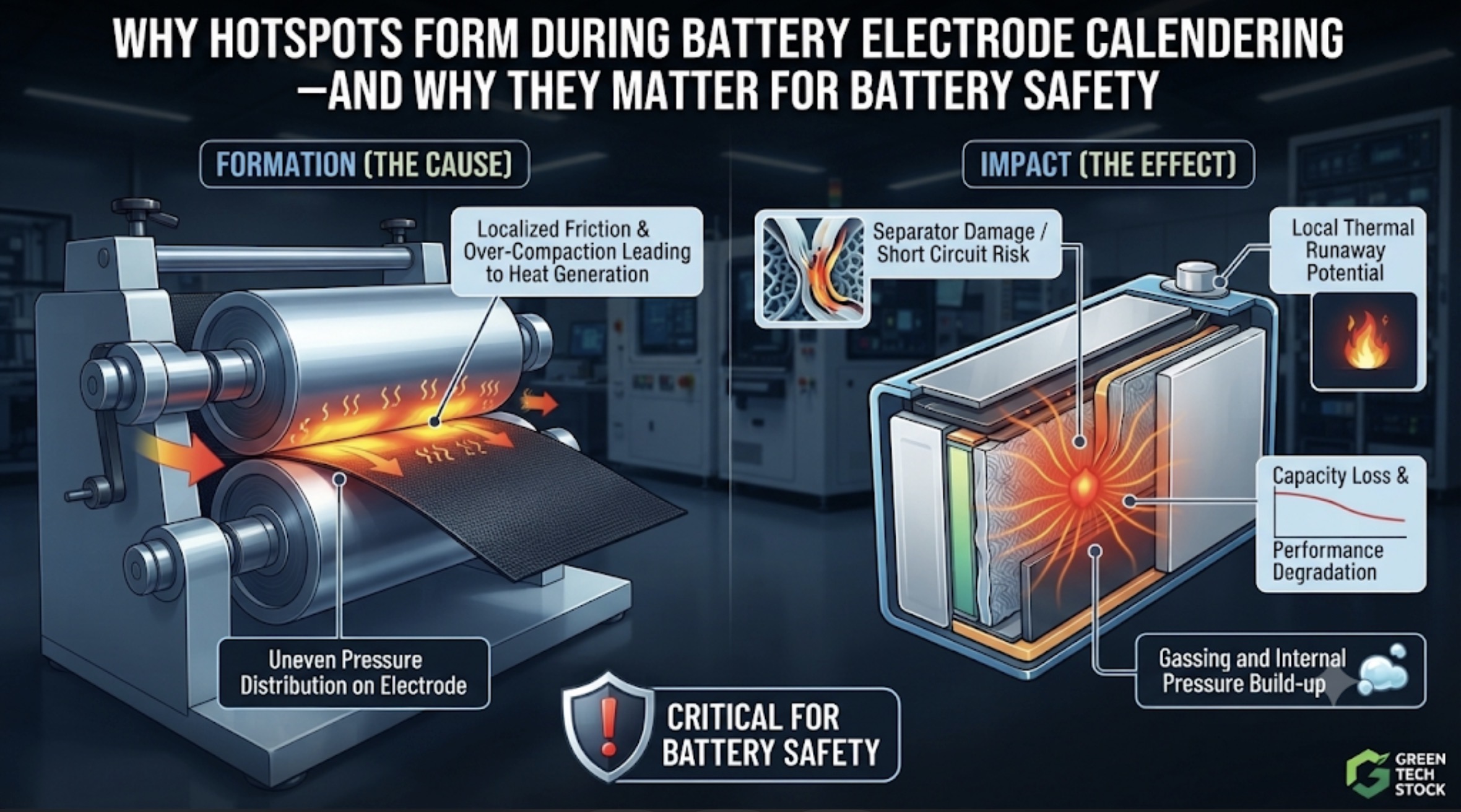
Among these processes, calendering plays a vital role. It improves electrode density, enhances particle contact, and increases volumetric energy density. However, when calendering is not properly controlled, it can create localized defects known as hotspots—areas that may significantly compromise battery safety.
In this article, we’ll explore how hotspots develop during the calendering process, why they are dangerous, and what manufacturers can do to prevent them.
What Is Calendering?
After slurry is coated and dried on the current collector, the electrode passes through two high-pressure steel rollers a process called calendering.
The primary objectives are:
- Increase electrode density
- Improve adhesion between particles
- Reduce porosity
- Enhance electrical conductivity
- Improve energy density
Although calendering appears to be a straightforward compression process, achieving uniform pressure across the entire electrode width is far more challenging than it seems.
What Is a Hotspot?
A hotspot is a localized region within the electrode where electrical and thermal behavior differs from the surrounding material.
Instead of current flowing evenly across the electrode, a hotspot attracts a disproportionate amount of current, resulting in localized heat generation.
This localized heating can accelerate material degradation and, under severe conditions, trigger thermal instability.
How Does a Hotspot Form During Calendering?
One of the most common causes is Heavy Edge.
When the coated electrode has thicker edges than the center, the calender rolls cannot apply pressure uniformly.
As a result:
- Certain regions become excessively compressed.
- Local electrode density increases.
- Electrical conductivity becomes uneven.
- Current preferentially flows through these dense regions.
This concentration of current produces localized heating, forming hotspots during battery operation.
In other words, a coating defect created upstream can evolve into a serious safety issue later in the manufacturing process.
Why Are Hotspots Dangerous?
1. Localized Overheating
Hotspots generate significantly more heat than surrounding regions.
Repeated charge and discharge cycles amplify this effect, accelerating:
- Electrolyte decomposition
- SEI layer degradation
- Active material deterioration
- Capacity fade
If heat cannot dissipate effectively, localized temperature continues increasing.
2. Mechanical Damage
Non-uniform compression also introduces mechanical stress into the electrode.
Engineers frequently observe:
- Edge cracking
- Electrode wrinkles
- Delamination
- Particle fracture
These defects reduce mechanical integrity and may eventually contribute to internal short circuits.
3. Reduced Battery Lifetime
Even when catastrophic failure does not occur, hotspots gradually reduce battery reliability.
Because current distribution becomes uneven, some regions age much faster than others.
This imbalance leads to:
- Faster capacity loss
- Increased internal resistance
- Reduced cycle life
- Lower long-term reliability
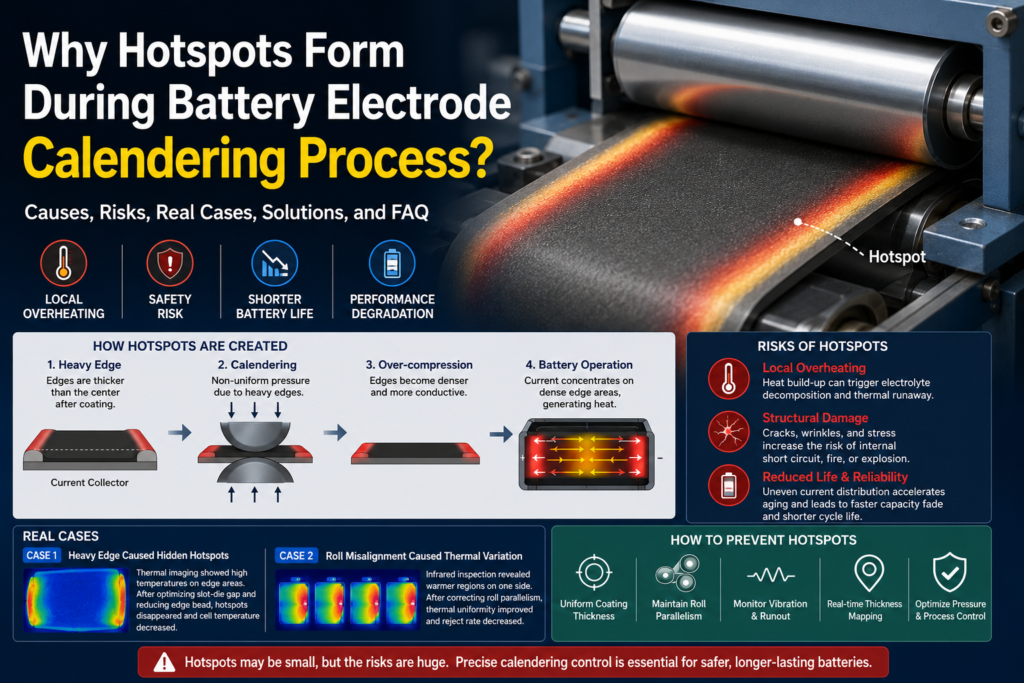
Practical Case 1: Heavy Edge Created Hidden Hotspots
In one production line, quality inspection found no significant problems after coating.
However, cells repeatedly exhibited elevated temperatures during high-rate discharge testing.
Engineers initially suspected electrolyte formulation or cell assembly.
After examining the electrodes, they discovered that excessive Heavy Edge caused uneven calendering pressure.
By optimizing the slot-die gap and reducing edge bead thickness, pressure distribution became more uniform.
The hotspot disappeared, and cell temperature during testing decreased noticeably without changing any battery materials.
This case illustrates how upstream coating quality directly influences downstream safety.
Practical Case 2: Roll Parallelism Solved Thermal Variation
Another manufacturer observed inconsistent thermal images during module testing.
Infrared cameras showed warmer regions appearing repeatedly along one side of multiple cells.
The root cause turned out to be slight misalignment between the calender rolls.
Although the difference measured only a few micrometers, pressure distribution across the electrode width was significantly affected.
After realigning the rolls and recalibrating the equipment, thermal uniformity improved substantially and reject rates decreased.
Sometimes, seemingly insignificant mechanical adjustments produce greater improvements than changing sophisticated battery materials.
My Perspective
In my opinion, hotspots are often misunderstood.
Many discussions focus exclusively on battery chemistry when safety issues arise.
However, real manufacturing experience shows that process quality is just as important as material quality.
A perfectly designed cathode chemistry cannot compensate for poor coating uniformity or unstable calendering.
Likewise, even high-performance active materials cannot eliminate defects introduced by inconsistent mechanical processing.
As battery manufacturers pursue thicker electrodes and higher production speeds, maintaining uniform compression will become increasingly challenging.
I believe future competitive advantage will depend not only on developing better materials but also on mastering precision manufacturing technologies capable of preventing hotspot formation before cells are assembled.
Best Practices for Preventing Hotspots
Manufacturers can reduce hotspot formation by implementing several process controls:
- Maintain uniform slot-die coating thickness.
- Minimize Heavy Edge before calendering.
- Regularly inspect calender roll parallelism.
- Monitor roll vibration and runout.
- Use online thickness mapping systems.
- Optimize calender pressure according to electrode density.
- Employ infrared thermal imaging during validation testing.
- Continuously monitor electrode density across the web width.
Rather than relying on a single adjustment, successful manufacturers optimize the entire production system.
Frequently Asked Questions (FAQ)
Q1. Does every Heavy Edge create a hotspot?
Not necessarily.
Small Heavy Edge defects may remain within acceptable manufacturing tolerances.
However, severe edge bead formation significantly increases the probability of uneven compression and localized heating.
Q2. Can hotspots be detected during manufacturing?
Yes.
Many manufacturers use online thickness measurement, density analysis, X-ray inspection, and infrared thermal imaging during process validation to identify potential hotspot risks before final cell assembly.
Q3. Are hotspots only related to calendering?
No.
Hotspots may originate from several manufacturing steps, including coating, drying, calendering, stacking, welding, or even cell aging.
Calendering is simply one of the most influential stages because it directly controls electrode density and contact resistance.
Conclusion
Hotspots formed during battery electrode calendering are far more than localized temperature increases.
They represent the combined effects of coating quality, pressure distribution, mechanical precision, and electrical uniformity.
Preventing hotspot formation requires a systematic manufacturing approach that integrates precise coating, optimized calendering, equipment alignment, real-time monitoring, and continuous process control.
As lithium-ion batteries continue evolving toward higher energy density and faster charging, manufacturing precision will remain one of the most important factors determining both battery performance and long-term safety.
References
- Wood, D. L., Li, J., & Daniel, C. (2015). Prospects for Reducing the Processing Cost of Lithium-Ion Batteries. Journal of Power Sources, 275, 234–242.
- Schabel, W., Scharfer, P., & Kind, M. (2004). Drying of Battery Electrodes: Fundamentals and Process Engineering. Drying Technology.
- Gutoff, E. B., & Cohen, E. D. (2016). Coating and Drying Defects: Troubleshooting Operating Problems (3rd Edition). Wiley.
- Li, J., Daniel, C., & Wood, D. L. (2011). Materials Processing for Lithium-Ion Batteries. Journal of Power Sources, 196(5), 2452–2460.
- Meyer, H. M., et al. (2020). Influence of Calendering on Lithium-Ion Battery Electrode Microstructure and Electrochemical Performance. Journal of Energy Storage.
- Zheng, H., et al. (2012). Effects of Calendering on Electrode Structure and Battery Performance. Journal of Power Sources, 208, 52–57.
- Bockholt, H., et al. (2016). Comprehensive Study of Calendering in Lithium-Ion Battery Manufacturing. Energy Technology.
- DuPont. Battery Electrode Coating and Calendering Process Guide. Technical Bulletin.