
When people think about lithium-ion batteries, they often focus on new materials such as solid-state electrolytes or silicon anodes. However, many battery engineers know that outstanding materials alone do not guarantee a high-quality battery.
The real difference is often made during electrode manufacturing.
Even if two manufacturers use identical raw materials, the company with better process control can produce batteries with higher energy density, longer cycle life, and significantly better production yield.
Many engineers describe electrode manufacturing as the stage where battery quality is truly created.
What Is the Electrode Manufacturing Process?
Electrode production consists of four major manufacturing stages.
- Mixing
- Coating
- Drying
- Calendering (Roll Pressing)
Each step directly influences battery performance, manufacturing cost, and production efficiency.
A single defect introduced early in the process often continues throughout the entire cell manufacturing sequence.
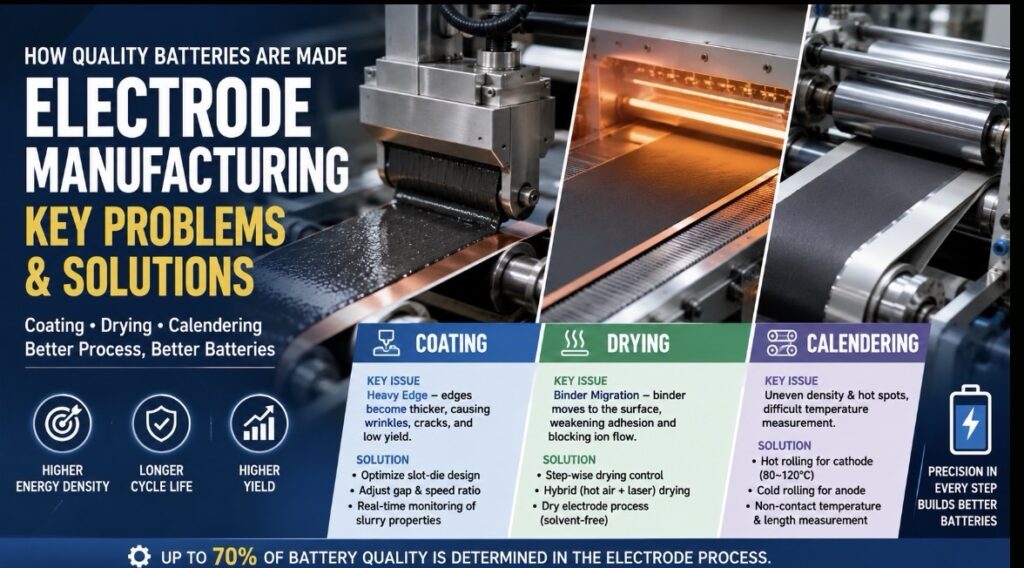
1. Coating Process: Eliminating the Heavy Edge Problem
The coating process spreads electrode slurry uniformly onto the current collector using a slot-die coating system.
Although the objective sounds simple, maintaining perfectly uniform thickness across the entire electrode is one of the biggest engineering challenges.
One common defect is known as Heavy Edge.
As slurry exits the slot die, surface tension causes the material to contract toward the center, making the electrode edges thicker than the middle.
Why Heavy Edge Matters
Uneven edges create several downstream problems:
- Non-uniform pressure during calendering
- Electrode wrinkles
- Micro-cracks
- Poor thickness consistency
- Lower manufacturing yield
Even small edge variations can eventually affect battery performance and reliability.
Practical Engineering Solutions
Battery manufacturers typically improve Heavy Edge by:
- Optimizing slot-die outlet geometry
- Adjusting coating gap
- Balancing coating speed with slurry flow rate
- Monitoring slurry viscosity in real time
- Using inline imaging systems to detect coating abnormalities before defects accumulate
Modern smart factories increasingly rely on AI-assisted inspection systems that identify coating issues immediately instead of waiting for post-process inspection.
2. Drying Process: Preventing Binder Migration
After coating, the solvent must evaporate inside a long drying oven.
However, drying introduces another major challenge known as Binder Migration.
As solvent evaporates, binder particles tend to move toward the electrode surface.
Instead of remaining evenly distributed, the binder accumulates near the top layer.
Why Binder Migration Is Dangerous
Excessive binder migration can cause:
- Reduced adhesion to the current collector
- Lower mechanical strength
- Blocked pore structure
- Reduced lithium-ion transport
- Faster battery degradation
- Shorter cycle life
Although the electrode may appear visually acceptable, its electrochemical performance may already be compromised.
Practical Production Solutions
Battery manufacturers reduce binder migration through several approaches.
Step-Wise Drying
Instead of immediately applying high temperature, manufacturers begin with lower temperatures before gradually increasing heat.
This allows solvent to evaporate more uniformly while reducing binder movement.
Hybrid Drying Technologies
Some production lines combine conventional hot-air drying with laser-assisted heating.
Laser energy provides more uniform internal heating, minimizing concentration gradients inside the coating layer.
Dry Electrode Manufacturing
Perhaps the most exciting development is dry electrode technology.
Because no solvent is used, the entire drying process is eliminated.
This removes binder migration almost completely while reducing factory energy consumption and lowering carbon emissions.
Many industry experts believe dry electrode manufacturing could become one of the biggest technological shifts in battery production during the coming decade.
3. Calendering: The Final Density Optimization
After drying, electrodes enter the calendering process.
Two precision rollers compress the electrode until the desired thickness and density are achieved.
Although the process appears straightforward, pressure and temperature control require exceptional precision.
Why Calendering Is Critical
Poor calendering may result in:
- Uneven density
- Lower energy density
- Higher internal resistance
- Localized hot spots
- Reduced battery lifetime
The electrode’s final microstructure is largely determined during this stage.
Different Strategies for Cathodes and Anodes
Manufacturers often use different temperature strategies depending on electrode chemistry.
Cathodes
Cathodes are commonly processed using hot calendering.
Typical temperatures range from 80°C to 120°C, improving binder activation and particle bonding.
Anodes
Graphite anodes are generally processed using cold calendering.
Lower temperatures help preserve graphite structure while maintaining mechanical stability.
Optimizing these temperature profiles can significantly improve both electrochemical performance and manufacturing consistency.
Advanced Process Monitoring
Modern gigafactories increasingly rely on non-contact measurement technologies.
Examples include:
- Infrared pyrometers for roller temperature monitoring
- Laser encoders for precise electrode length measurement
- Machine vision systems for surface inspection
- Real-time thickness measurement
- AI-based defect classification
Instead of reacting after defects occur, manufacturers now focus on preventing defects before they propagate through production.
Why Electrode Manufacturing Matters More Than Ever
Battery innovation is no longer driven solely by chemistry.
Manufacturing precision has become just as important as material innovation.
As electric vehicle demand continues growing, manufacturers face increasing pressure to improve:
- Production yield
- Manufacturing speed
- Energy efficiency
- Product consistency
- Cost competitiveness
Companies capable of producing high-quality electrodes consistently will likely become the long-term leaders in the global battery industry.
Field Example: How a small Harvey edge defect reduced production yield
In one lithium-ion battery production line, engineers observed frequent thickness variation after calendering despite stable coating conditions.
The root cause was eventually tracked back to a Heavy edge issue during slot-die coating.
The electrode edge thickness was only about 6-8 um thicker than the center region, which initially apperared acceptable. However, after calendering, the pressure distribution became non-uniform, causing localized density variation near both edges.
As a result:
-. Electrode thickness Cpk decreased significantly
-. Egde cracking frequency increased during slitting
-. Yield dropped by approximately 3-4%
The engineering team sloved the issue by reducing the coating gap and optimizing slurry flow distribution at the slot-die outlet. After implementation, thickness uniformity improved and yield recovered within several weeks.
This case demonstrated how even a seemingly minor defect car propagate throughout the entire manufacuring process.
Final Thoughts
Many engineers say that nearly 70% of battery quality is determined during electrode manufacturing, and it is easy to understand why.
Every stage—from slurry mixing to coating, drying, and calendering—creates opportunities for either exceptional quality or costly defects.
As next-generation batteries continue evolving, advances in electrode manufacturing technologies—including AI inspection, smart process control, and dry electrode production—may prove just as transformative as breakthroughs in battery chemistry itself.
References
1. Tarascon, J.-M. & Armand, M. (2001).
Issues and challenges facing rechargeable lithium batteries. Nature, 414, 359–367.
2. Nitta, N., Wu, F., Lee, J.T., & Yushin, G. (2015).
Li-ion battery materials: present and future. Materials Today, 18(5), 252–264.
3. Wood, D.L., Li, J., & Daniel, C. (2015).
Prospects for reducing the processing cost of lithium-ion batteries. Journal of Power Sources, 275, 234–242.
4. Zheng, H., Li, J., Song, X., Liu, G., Battaglia, V.S. (2012).
A comprehensive understanding of electrode microstructure in lithium-ion batteries. Journal of The Electrochemical Society, 159(3), A240–A248.
5. Zhang, S.S. (2007).
The effect of the charging protocol on the cycle life of a Li-ion battery. Journal of Power Sources, 161(2), 1385–1389.