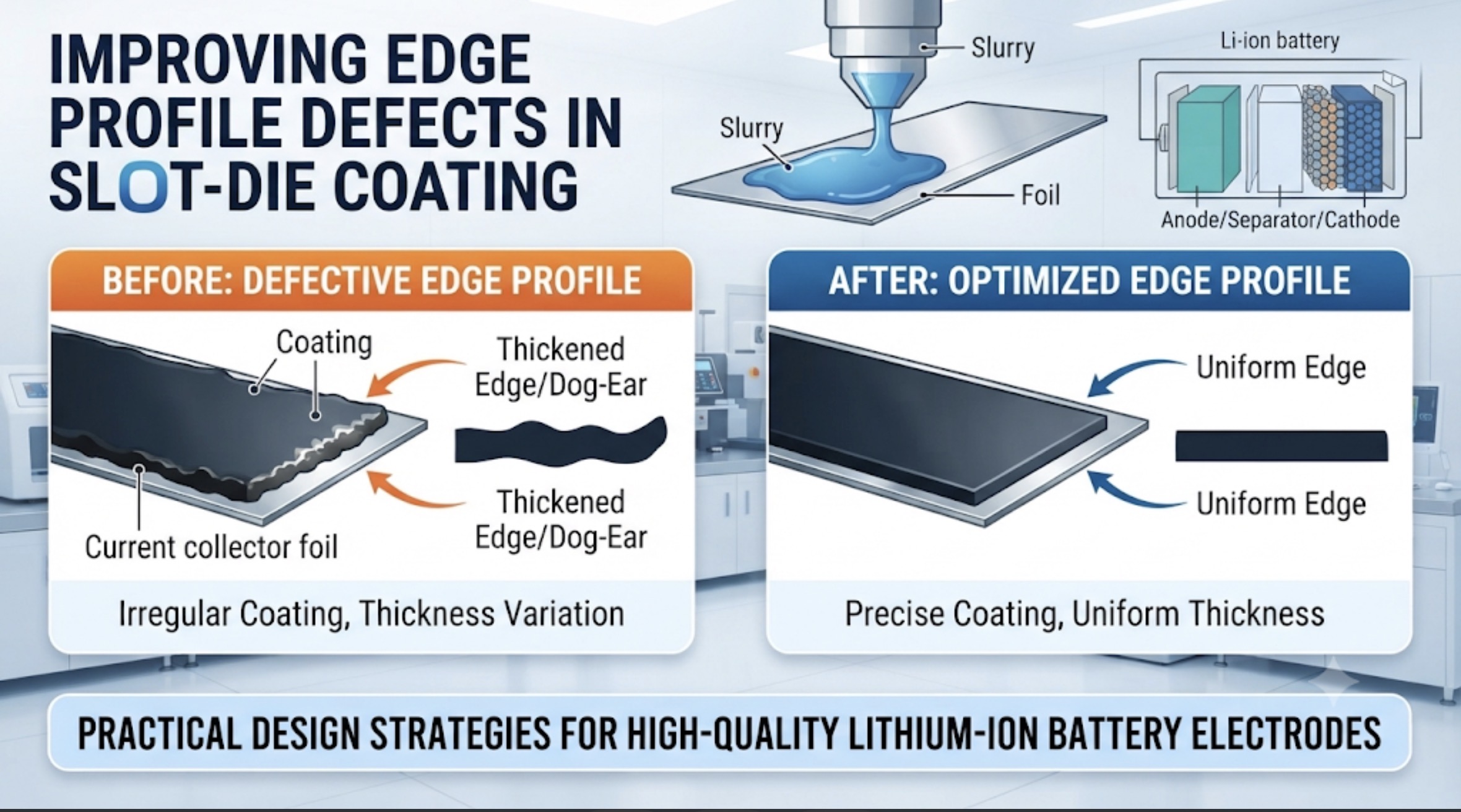
Slot-die coating is one of the most important manufacturing processes in lithium-ion battery production. It enables highly uniform coating, excellent material utilization, and compatibility with high-speed roll-to-roll manufacturing. Compared with conventional coating methods, slot-die coating minimizes material waste while achieving precise control of electrode thickness, making it the preferred technology for electric vehicle (EV) batteries and energy storage systems (ESS).
Despite these advantages, manufacturers continue to face one critical challenge—edge profile defects. Although these defects occur only near the edges of the coated electrode, they can significantly affect coating quality, electrode uniformity, drying behavior, calendering performance, and even the electrochemical performance of the finished battery.
As battery manufacturers push toward thinner electrodes, higher coating speeds, and tighter quality requirements, understanding and controlling edge defects has become increasingly important.
What Are Edge Profile Defects?
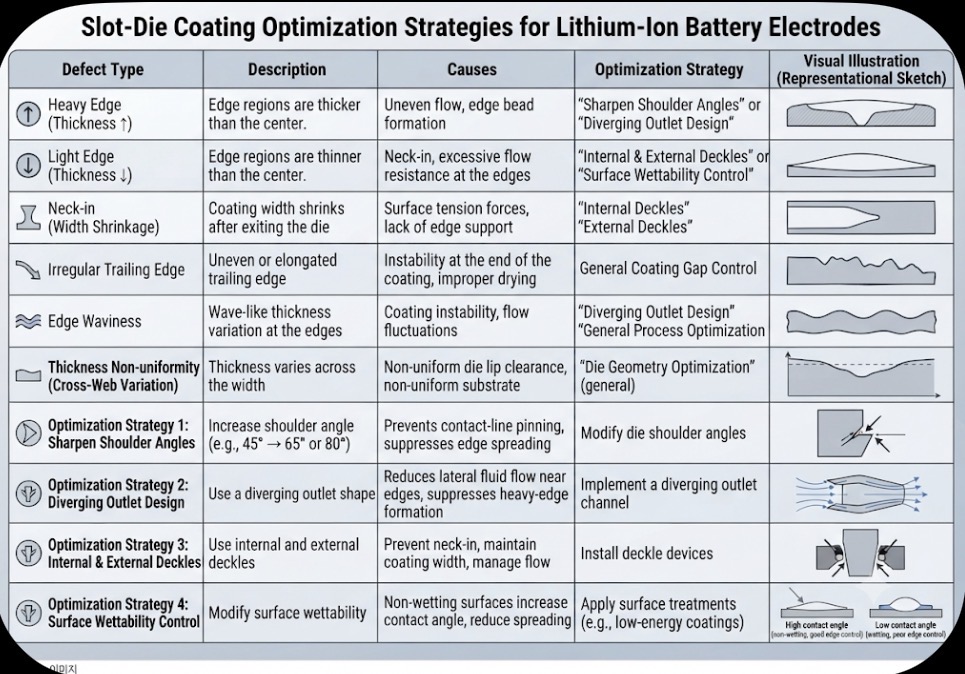
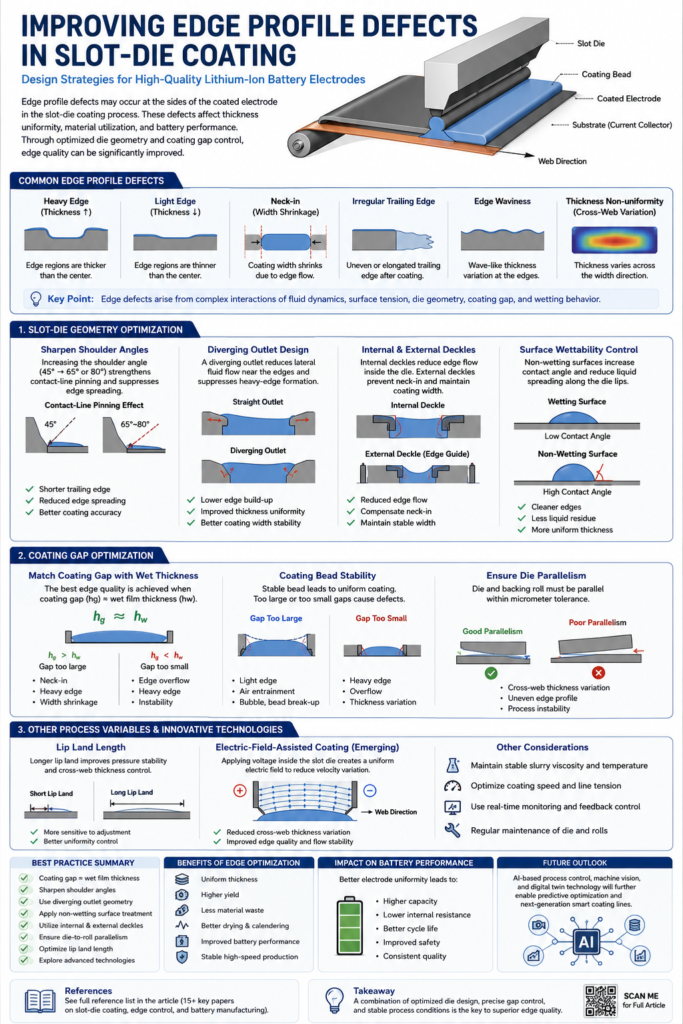
Edge profile defects refer to abnormalities that appear near the sides of the coated electrode rather than in the center region. Typical defects include heavy edges, light edges, neck-in, uneven trailing edges, edge waviness, and cross-web thickness variations.
These defects are primarily caused by the complex interaction between slurry rheology, surface tension, die geometry, coating gap, substrate movement, and wetting behavior. Because fluid near the coating boundaries behaves differently from fluid in the center, maintaining uniform edge quality requires careful engineering.
Even small edge defects can propagate through downstream processes such as drying, calendering, slitting, and cell assembly, ultimately reducing battery yield and reliability.
1. Improving Edge Quality Through Slot-Die Geometry Optimization
Sharper Die Shoulder Angles
The shoulder angle at the die exit strongly influences the movement of the coating bead’s contact line.
Researchers have demonstrated that increasing the shoulder angle from approximately 45° to 65° or even 80° creates a stronger contact-line pinning effect. This effect prevents the liquid meniscus from moving excessively during coating, resulting in a cleaner and more precisely defined edge.
Benefits include:
- Shorter trailing edges
- Reduced edge spreading
- Improved intermittent coating
- Higher coating accuracy
Instead of allowing slurry to spread uncontrollably after leaving the die, a sharper shoulder stabilizes the liquid exactly where coating should begin and end.
Diverging Die Outlet Design
Another effective modification involves changing the die outlet geometry.
A diverging outlet gradually expands toward the exit, reducing lateral flow near the coating edges. This design minimizes slurry accumulation at both sides of the coating bead and suppresses heavy-edge formation.
Advantages include:
- Lower edge thickness variation
- Improved coating width stability
- Reduced edge build-up
- Better thickness uniformity
This approach is particularly useful in high-speed coating operations where fluid inertia becomes more significant.
Internal and External Deckles
Deckles provide another practical solution for edge control.
Internal deckles regulate slurry flow inside the slot die before it exits the coating slot. By reducing flow near the die edges, they compensate for neck-in and improve thickness distribution across the web.
Meanwhile, external deckles physically guide the slurry curtain at the die lips, maintaining coating width and preventing excessive contraction caused by surface tension.
The combination of both systems significantly enhances edge stability and reduces material waste.
Surface Wettability Engineering
The surface properties of the die also influence edge formation.
Applying non-wetting surface treatments increases the contact angle between the slurry and the die surface. As a result, the liquid is less likely to spread along the die lips.
The benefits include:
- Cleaner coating edges
- Reduced liquid residue
- Better trailing-edge definition
- Improved coating consistency
Surface engineering offers an attractive solution because it improves edge quality without major modifications to the coating equipment.
2. Optimizing the Coating Gap
Among all process variables, the coating gap is one of the most influential.
The coating gap determines the stability of the liquid bridge, commonly called the coating bead, between the slot die and the moving substrate.
Matching the Gap with Wet Film Thickness
Experimental and theoretical studies suggest that the best edge quality is achieved when the coating gap is approximately equal to the wet coating thickness.
When the coating gap becomes significantly larger than the wet film thickness:
- Neck-in becomes more severe.
- Heavy-edge defects increase.
- Coating width decreases.
- Thickness uniformity deteriorates.
Maintaining the proper gap stabilizes the coating bead while minimizing undesirable edge flow.
Maintaining Bead Stability
A stable coating bead is essential for defect-free coating.
If the coating gap is too large, the liquid bridge becomes unstable, leading to:
- Light edges
- Air entrainment
- Bubble formation
- Bead break-up
Conversely, if the gap is too small, excessive pressure forces slurry toward the coating edges, resulting in:
- Heavy edges
- Overflow
- Edge flooding
- Thickness variation
Finding the optimal operating window is therefore essential for stable manufacturing.
Ensuring Die Parallelism
Gap adjustment alone is insufficient if the slot die is not perfectly aligned with the backing roll.
Even a slight angular misalignment can produce significant cross-web thickness variation.
Therefore, manufacturers routinely verify die-to-roll parallelism within micrometer tolerances to maintain consistent coating quality across the entire electrode width.
3. Additional Process Improvements
Lip Land Length
The lip land is the final straight section before slurry exits the die.
Longer lip lands generally improve pressure stabilization and allow finer adjustment of cross-web thickness. Although the optimal length depends on slurry viscosity and coating speed, appropriate lip land design increases process robustness and edge stability.
Electric-Field-Assisted Slot-Die Coating
Recent research has introduced electric-field-assisted slot-die coating as an innovative approach to improving coating uniformity.
By applying a controlled electric field within the slot die, researchers have demonstrated improved slurry velocity distribution and reduced cross-web thickness variation.
Although still under development, this technology has the potential to further reduce edge defects in next-generation battery manufacturing.
Best Engineering Practices
To minimize edge profile defects, manufacturers should consider the following guidelines:
- Match the coating gap as closely as possible to the wet film thickness.
- Increase die shoulder angles to strengthen contact-line pinning.
- Adopt diverging outlet geometries to suppress heavy-edge formation.
- Apply non-wetting surface treatments to reduce edge spreading.
- Utilize internal and external deckles for better edge flow control.
- Maintain precise die-to-roll parallelism using micrometer-level alignment.
- Optimize lip land length according to slurry rheology.
- Evaluate advanced technologies such as electric-field-assisted coating for future production lines.
Successful edge control is achieved through the combination of optimized die design, precise mechanical alignment, and stable process conditions rather than a single design modification.
Conclusion
Edge profile defects remain one of the most challenging issues in slot-die coating for lithium-ion battery electrodes. While these defects may appear only near the coating boundaries, they can influence every downstream manufacturing step, including drying, calendering, slitting, and final cell assembly.
Modern battery manufacturing requires not only precise slurry formulation but also sophisticated engineering of die geometry, coating gap, wettability, and process stability. By integrating these optimization strategies, manufacturers can significantly improve coating quality, reduce production waste, enhance electrode uniformity, and ultimately produce safer and higher-performance batteries.
As electric vehicle and energy storage markets continue to expand, advanced slot-die coating technologies will play an increasingly important role in achieving the next generation of high-energy-density batteries.
Frequently Asked Questions (FAQ)
Q1. Why are edge profile defects important in lithium-ion battery manufacturing?
Edge defects directly affect coating uniformity, electrode dimensions, drying consistency, and calendering performance. Poor edge quality can reduce battery yield, increase material waste, and negatively impact cell performance.
Q2. What is the most important parameter for controlling edge defects?
The coating gap is generally considered the most critical parameter. Matching the coating gap to the wet film thickness provides the most stable coating bead and significantly improves edge quality.
Q3. How does die geometry influence edge formation?
Die geometry controls slurry flow at the die exit. Sharper shoulder angles, diverging outlets, and optimized deckle designs help stabilize the contact line and reduce unwanted edge spreading.
Q4. Can surface treatments improve coating quality?
Yes. Non-wetting surface treatments increase the contact angle between the slurry and the die, minimizing liquid spreading and producing cleaner, more uniform coating edges.
Q5. What future technologies may further reduce edge defects?
Emerging technologies such as electric-field-assisted slot-die coating, AI-based process monitoring, real-time machine vision inspection, and digital twin manufacturing are expected to significantly improve coating precision and manufacturing efficiency.
References
- Carvalho, M. S., & Kheshgi, H. S. “Low-flow limit in slot coating: Theory and experiments.” AIChE Journal.
- Romero, O. J., & Carvalho, M. S. “Effect of die geometry on slot coating performance.” Chemical Engineering Science.
- Lee, J., et al. “Edge profile optimization using diverging slot-die outlet geometry.” Journal of Coating Technology and Research.
- Meyerhofer, D. “Characteristics of resist films produced by spinning.” Journal of Applied Physics.
- Weinstein, S. J., & Ruschak, K. J. Coating Flows. Annual Review of Fluid Mechanics.
- Kistler, S. F., & Schweizer, P. M. Liquid Film Coating. Chapman & Hall.
- Scriven, L. E. “Physics and applications of coating and printing.” MRS Bulletin.
- Ruschak, K. J. “Coating flows.” Annual Review of Fluid Mechanics.
- Gutoff, E. B., & Cohen, E. D. Coating and Drying Defects: Troubleshooting Operating Problems.
- Han, C., et al. “Experimental investigation of coating bead stability in slot-die coating.” Chemical Engineering Research and Design.
- Lee, S., et al. “Optimization of slot-die coating parameters for lithium-ion battery electrodes.” Journal of Power Sources.
- Schabel, W., et al. “Slot-die coating process window analysis.” Progress in Organic Coatings.
- Park, J., et al. “Influence of coating gap on electrode quality in lithium-ion battery manufacturing.” Energy Technology.
- Wood, D. L., et al. “Advanced manufacturing for lithium-ion batteries.” JOM.
- Yuan, J., et al. “Precision slot-die coating for battery electrode fabrication.” ACS Applied Energy Materials.