Last Updated: July 2026
Disclosure: This article is intended for general educational purposes and reflects publicly available battery science research. It is not professional engineering or investment advice.
Battery Degradation Explained: Why Lithium-Ion Batteries Lose Capacity Over Time
I get asked some version of this question constantly: “why does my phone battery feel so much worse than it did last year, even though I barely dropped it or abused it?” The honest answer is that lithium-ion batteries lose capacity simply by existing — a process called battery degradation, and it’s happening whether we notice it or not. It’s one of the most important factors behind battery lifespan, driving range, charging speed, and overall reliability across smartphones, EVs, and energy storage systems (ESS).
Degradation can’t be stopped entirely, but understanding why it happens genuinely changes how you use and think about batteries. I want to walk through the chemistry behind it, what accelerates it, and what’s actually changing in how the industry fights it.
What Is Battery Degradation?
Battery degradation is the gradual decline in a battery’s ability to store and deliver electrical energy. As it progresses, the battery can no longer hold its original capacity, and its internal resistance creeps upward.
Think of a battery that originally stored 100 kWh. After years of use, it might only hold 85 kWh. It still works — but you’ll notice shorter driving range, less runtime, and sometimes slower charging.
I think this point matters more than people realize: degradation on its own isn’t a defect. It’s a normal, expected part of how these batteries age. The real question is how fast it happens and whether it’s happening faster than it should.
Two Types of Battery Aging
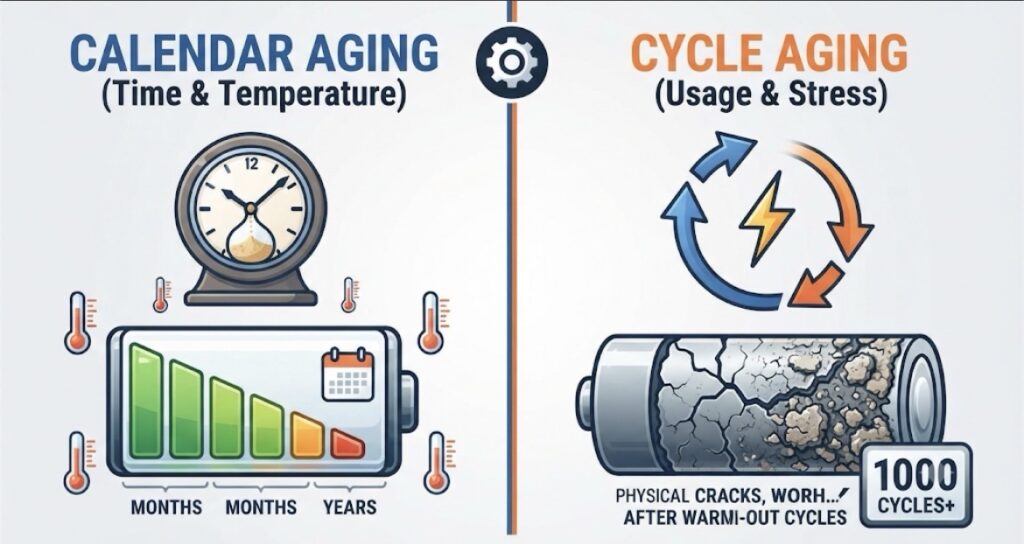
There are two distinct mechanisms at work, and I find it helps to separate them mentally.
1. Calendar Aging
Calendar aging happens purely because time passes — even for a battery that’s barely used. Chemical reactions inside the cell continue regardless. High storage temperatures and sitting at a high state of charge both speed this up considerably. It’s why a battery left untouched in a drawer for a few years still comes out weaker than when it went in.
2. Cycle Aging
Cycle aging comes from actual use — every charge and discharge cycle moves lithium ions between the anode and cathode, and that movement creates real mechanical and chemical stress inside the cell. More cycles simply mean more accumulated wear on the internal components.
In practice, most real-world batteries experience both simultaneously, which is part of why degradation curves can look different from one device to the next even under similar conditions.
Why Do Batteries Degrade? The Chemistry Behind It
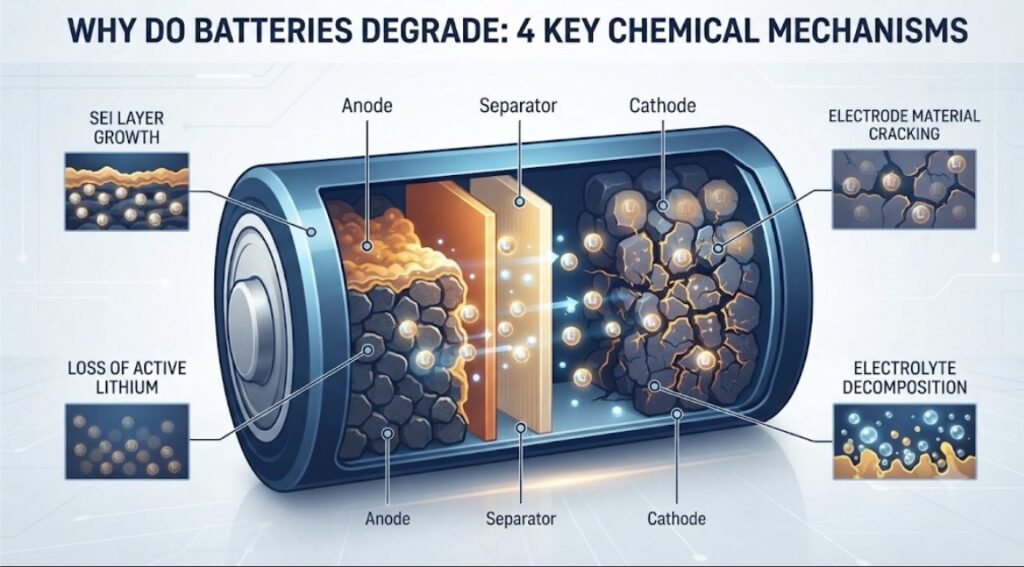
SEI layer growth. A protective film called the Solid Electrolyte Interphase (SEI) forms on the graphite anode during a battery’s earliest charge cycles. It’s essential for stability, but it keeps growing slowly over the battery’s entire life, consuming active lithium as it does.
Loss of active lithium. Some lithium ends up trapped in unwanted chemical compounds and simply stops participating in future charge cycles. Less active lithium means less usable capacity, in a fairly direct relationship.
Electrode cracking. Electrode materials physically expand and contract with every cycle. Over thousands of cycles, this creates microscopic cracks that reduce electrical contact and slow lithium-ion movement.
Electrolyte decomposition. High voltage and elevated temperature break the electrolyte down, generating unwanted gas and raising internal resistance — and yes, this is the same underlying process that, taken further, can lead to battery swelling.
What Accelerates Degradation?
A handful of external factors make a measurable difference:
- Frequent exposure to temperatures above 40°C
- Repeated fast charging combined with high heat
- Leaving a battery fully charged for extended periods
- Deep discharging down to near 0% regularly
- Weak or inadequate cooling systems
- Lower-quality manufacturing processes
A well-designed Battery Management System (BMS) helps limit these effects by actively controlling charging voltage, current, and operating temperature — but it can only work within the physical limits of the cell itself.
The Role of Manufacturing Quality
Degradation doesn’t depend solely on how a battery gets used. In my view, manufacturing quality carries just as much weight, and it’s the piece that gets the least public attention.
Production steps like slurry mixing, slot-die coating, drying, calendering, electrolyte filling, and formation all directly shape long-term durability. Poor execution at any one of these stages can produce uneven electrode thickness, particle clustering, elevated internal resistance, localized hot spots, and faster capacity fade — regardless of how carefully the end user treats the battery afterward.
This is exactly why leading battery manufacturers pour so much investment into precision manufacturing. A small defect at the production stage compounds over thousands of cycles into a real difference in usable lifespan.
How to Slow Battery Degradation
Degradation is unavoidable, but these habits genuinely slow it down:
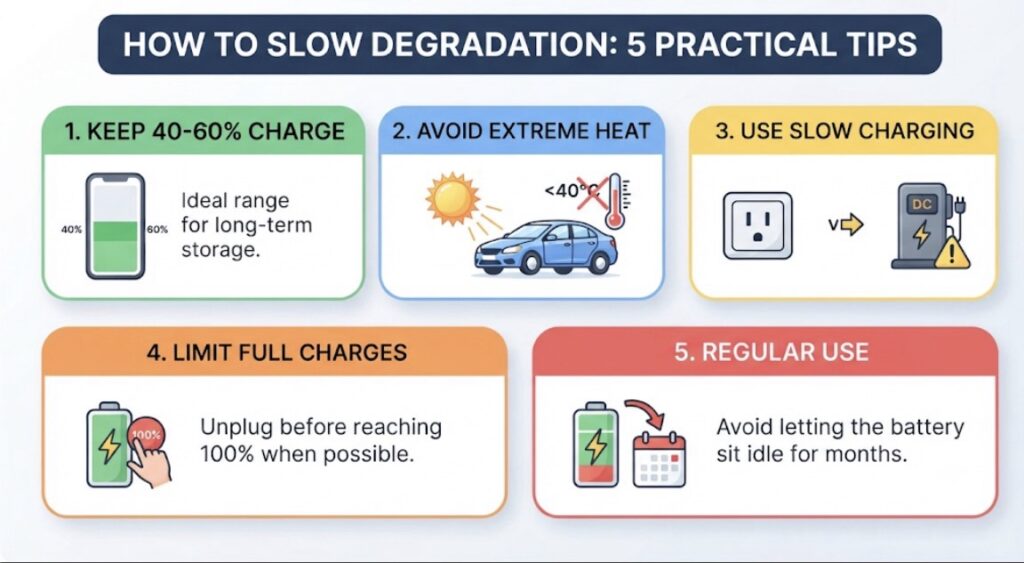
- Keep batteries within a moderate temperature range whenever possible.
- Avoid frequent full discharge cycles.
- Reserve fast charging for when you actually need it.
- Store unused batteries at roughly 40–60% charge.
- Use manufacturer-approved charging equipment.
- Keep battery management software up to date.
None of these are dramatic changes, but consistently applied, they can meaningfully extend a battery’s useful life by years rather than months.
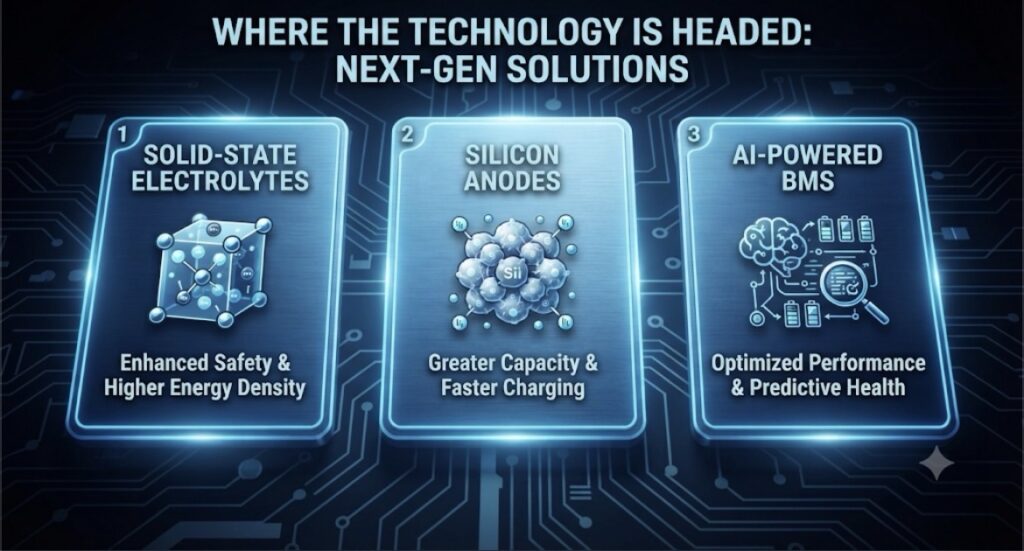
Where the Technology Is Headed
Research in this space has moved quickly. Solid-state batteries replace liquid electrolytes with solid materials, which reduces the side reactions that drive both degradation and swelling, while also improving thermal stability.
Silicon-based anodes are another major area of interest — they offer meaningfully higher energy density than traditional graphite, but they expand and crack more aggressively during cycling, which is exactly why so much current research is focused on better binder technologies and structural designs to manage that expansion.
What I find most practically interesting, though, is what’s happening on the software side. AI-based degradation prediction and adaptive charging algorithms are now being used to model battery health with a fairly high degree of accuracy, and early data suggests adaptive AI-driven charging strategies can meaningfully reduce degradation compared with static charging profiles. It’s not a replacement for good chemistry and good manufacturing, but it’s a real, measurable lever on top of both.
I think…
Battery degradation gets talked about like a fixed, unavoidable weakness of lithium-ion chemistry, but I think that framing undersells how much control we actually have over it. Lifespan depends on chemistry, yes — but just as much on manufacturing precision, thermal management, and even the software making charging decisions in the background.
What’s changed in just the last couple of years is how many levers we now have working at once: better electrode manufacturing, smarter BMS design, silicon-anode research pushing energy density up, and AI models that can flag a degrading cell before a user ever notices a problem. None of these fixes degradation outright, but stacked together, they’re meaningfully shifting how long a modern battery can be expected to last — and I think that trend has real staying power.
This is a good example of how degradation isn’t always about the chemistry going “wrong” in a complex way — sometimes it’s a design parameter that was overlooked, and the fix is straightforward once you identify it. It’s also a reminder that generic electrolyte fill specs shouldn’t be treated as one-size-fits-all across different cell designs.
Frequently Asked Questions
Is battery degradation the same as a defect?
No. Some capacity loss over time is completely normal and expected. It only becomes a concern when it happens noticeably faster than typical for that battery’s age and usage pattern.
Does calendar aging happen even if I never use my device?
Yes. Time and storage conditions alone — especially heat and high state of charge — will gradually degrade a battery even with minimal use.
Can degradation lead to battery swelling?
They’re related but not identical. Electrolyte decomposition, one of the core degradation mechanisms, can also generate gas that contributes to swelling in more advanced cases.
Do silicon anodes degrade faster than graphite?
Currently, yes, largely due to more severe expansion and cracking during cycling. Researchers are actively working on binder and structural solutions to close that gap while keeping silicon’s higher energy density.
Can AI actually slow down battery degradation?
AI itself doesn’t change the chemistry, but AI-driven adaptive charging and predictive health monitoring can reduce unnecessary stress on a battery and catch problems earlier, which in practice can meaningfully extend usable life.
Industry Insight: A Real Failure Case
One degradation case that stands out from my work involved a customer issue during life-cycle evaluation. A cell failed prematurely during testing, and when we opened it up for analysis, we found the electrolyte had essentially dried out — there wasn’t enough left to sustain the ion transport the cell needed.
The root cause traced back to electrolyte fill volume relative to cell loading. Higher-loading cells (more active material per unit area) require proportionally more electrolyte to fully wet the electrodes and sustain performance over the cell’s lifetime — simply using a standard fill volume regardless of loading isn’t enough. Our recommendation to the customer was to scale up electrolyte volume based on the specific loading of their cell design.
This is a good example of how degradation isn’t always about the chemistry going “wrong” in a complex way — sometimes it’s a design parameter that was overlooked, and the fix is straightforward once you identify it. It’s also a reminder that generic electrolyte fill specs shouldn’t be treated as one-size-fits-all across different cell designs.
Sources
Sources
- Choi et al., Degradation Pathways of Silicon-Based Anodes in Lithium-Ion Batteries, Advanced Energy Materials (2026)
- PatentPC, The Impact of AI on Battery Technology (2026)
Related Articles
- What Determines Battery Lifespan?
- Why Batteries Swell: Understanding the Causes, Risks, and Prevention
- Understanding Battery Thermal Runaway
- Why Electrode Manufacturing Determines Battery Performance
- LFP vs NCM Batteries: Which Chemistry Lasts Longer?