Artificial intelligence has officially transformed the global semiconductor industry into one of the fastest-growing, most strategically vital sectors in the global economy.
Today, companies like NVIDIA, TSMC, Samsung Electronics, SK Hynix, and ASML have evolved into household names among retail and institutional investors alike. However, gaining exposure to this massive structural paradigm shift by purchasing individual semiconductor stocks comes with one major, unavoidable challenge: extreme volatility.
A single quarterly earnings miss, a sudden macro export restriction, or a shift in geopolitical trade policies can cause individual chip stocks to swing dramatically by 10% to 20% within a matter of days.
For growth-oriented investors who firmly believe in the long-term secular adoption of AI but want to drastically mitigate company-specific operational risk, semiconductor exchange-traded funds (ETFs) offer a much more balanced, defensive investment approach.
Instead of trying to predict which specific company will win tomorrow’s highly competitive chip wars, semiconductor ETFs allow capital allocators to participate in the entire industry’s overall expansion. By owning a diversified basket, you gain exposure to dozens of key players spanning the entire semiconductor value chain.
In this comprehensive guide, we will deeply evaluate and compare three of the most popular semiconductor ETFs for long-term investors in 2026, breaking down which fund aligns best with your specific risk tolerance.
Why Choose Semiconductor ETFs Over Individual Stocks?
Many first-time investors make the structural mistake of concentrating too much capital into a single high-profile tech stock. While companies like NVIDIA have delivered historic, life-changing returns over recent years, financial history consistently demonstrates that even absolute industry leaders experience severe periods of localized volatility.
A sudden bottleneck in AI infrastructure capital expenditures or a temporary slowdown in hyperscale datacenter spending can put intense pressure on even the structurally strongest businesses.
Semiconductor ETFs eliminate this centralized vulnerability by spreading your capital across multiple companies handling distinct segments of the chip industry. Through a diversified ETF architecture, investors simultaneously gain leveraged exposure to:
- AI Chip Designers & Architecture Firms (Fabless)
- High-Performance Memory Manufacturers (DRAM, HBM, NAND)
- Bleeding-Edge Semiconductor Equipment Suppliers (Lithography, Etching)
- Pure-Play Contract Fabrication Facilities (Foundries)
- Advanced Turnkey Packaging & Substrate Specialists
- Essential Chemical & Raw Material Manufacturers
This extensive diversification effectively flattens individual stock volatility while fully preserving your exposure to the long-term technological upside of global electrification.
The Structural Demand: Why Semiconductors Still Have Multi-Year Growth Runway
One critical macroeconomic shift that deserves closer attention is that semiconductor demand is expanding far beyond its legacy use-cases in consumer electronics, such as smartphones and personal computers.
Today, the chip industry acts as the foundational infrastructure powering the next industrial revolution, heavily driven by:
- Generative AI & LLM Training Models
- Next-Generation Hyperscale Cloud Datacenters
- Level 4/5 Autonomous Vehicles & Advanced Telematics
- Smart Factory Industrial Automation & Modern Robotics
- Edge Computing Components & Low-Latency Enterprise Networks
- Energy-Efficient Infrastructure Power Grids
Because these rapid-growth industries require increasingly complex microprocessors and ultra-dense memory modules, semiconductor manufacturers are transitioning from cyclical hardware providers into highly valued, recurring strategic infrastructure gatekeepers. From an institutional perspective, this structural shift explains why global capital allocators continue to aggressively increase their core semiconductor exposure despite short-term market corrections.
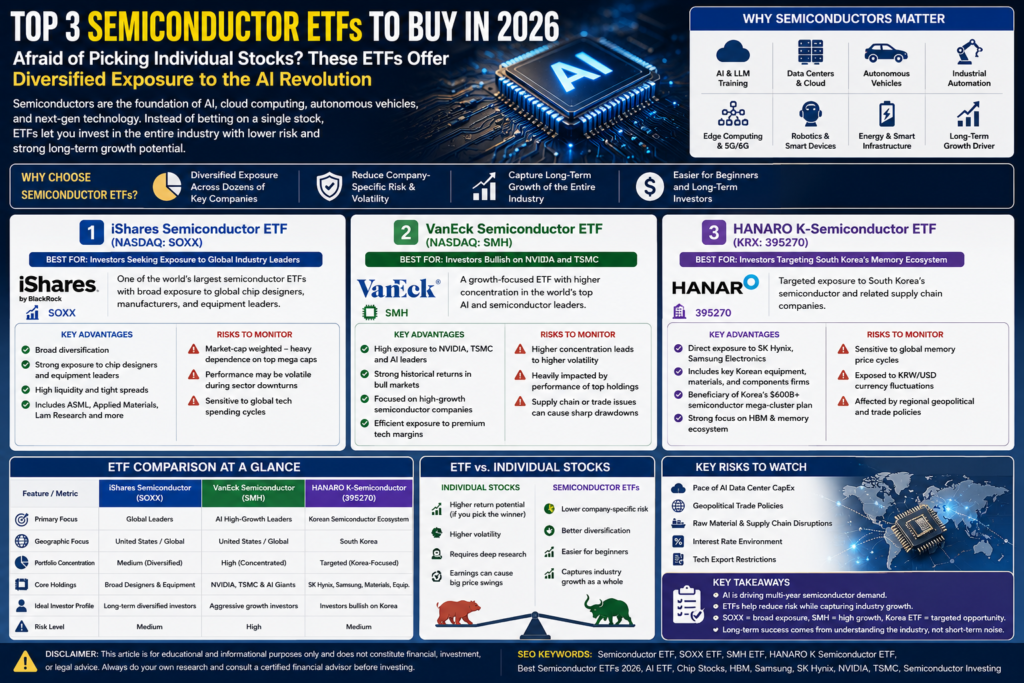
ETF #1: iShares Semiconductor ETF (NASDAQ: SOXX)
Best for Investors Seeking Exposure to Global Industry Leaders
SOXX stands as one of the world’s largest, most highly liquid semiconductor ETFs in the asset management space. It tracks a market-cap-weighted index composed of the primary US-listed giants involved in chip design, contract manufacturing, and complex equipment supply.
Key Advantages
- Exceptional daily trading liquidity and narrow bid-ask spreads.
- Balanced exposure across major US chip designers and global tier-1 equipment leaders like ASML, Applied Materials, and Lam Research.
- Comprehensive asset diversification that captures the baseline growth of the global hardware market.
Potential Risks to Monitor
Because SOXX uses a market-cap-weighted formula, its overall price performance can still become heavily dependent on a handful of top mega-cap holdings. If sector-wide tech spending faces a macro slowdown, the fund will experience localized volatility.
ETF #2: VanEck Semiconductor ETF (NASDAQ: SMH)
Best for Investors Who Are Ultra-Bullish on NVIDIA and TSMC
SMH is another legendary vehicle in the semiconductor space, but it employs a fundamentally different, more concentrated portfolio strategy compared to SOXX. SMH allows its top holdings to command significantly larger weights, making its performance heavily correlated to the true champions of the AI revolution: NVIDIA and TSMC.
Key Advantages
- Maximized, direct exposure to the world’s most dominant AI GPU designer (NVIDIA) and the world’s leading advanced chip foundry (TSMC).
- Aggressive growth profile that historically outperforms broader indices during structural semiconductor bull markets.
- Excellent allocation efficiency for investors who want to target premium tech margins.
Potential Risks to Monitor
Higher concentration inherently introduces higher volatility. If its core holdings face custom validation delays or regional supply chain bottlenecks, SMH will experience deeper drawdowns than broader, more evenly distributed ETFs.
ETF #3: HANARO K-Semiconductor ETF (KRX: 395270)
Best for Investors Targeting South Korea’s Advanced Memory Ecosystem
For investors looking to specifically isolate and capitalize on South Korea’s dominant global position in memory architecture and HBM packaging, the HANARO K-Semiconductor ETF provides an exceptional targeted vehicle. Rather than relying solely on a single stock, this ETF maps the entire specialized domestic supply chain.
Key Advantages
- Direct exposure to the core engines of the AI memory supercycle: SK Hynix and Samsung Electronics.
- Deep asset allocation into crucial domestic “Sub-Changer” (소부장) companies specializing in advanced etching equipment, testing components, and chemical inputs.
- High potential to act as the primary beneficiary of South Korea’s massive $600 billion localized semiconductor mega-cluster initiatives.
Potential Risks to Monitor
The fund’s performance is closely tied to global memory chip pricing cycles, regional currency fluctuations (KRW/USD), and broader East Asian geopolitical trade policies.
Head-to-Head ETF Comparison
Feature / Metric iShares Semiconductor (SOXX) VanEck Semiconductor (SMH) HANARO K-Semiconductor (395270) Primary Geographic Focus United States / Global Leaders United States / Global High-Growth South Korea Domestic Ecosystem Portfolio Concentration Medium (Diversified Cap-Weight) High (Concentrated in Top Holdings) Targeted (Memory & Supply Chain Focused) Core Holdings Focus Broad Designers & Equipment NVIDIA, TSMC & AI Giants SK Hynix, Samsung, Advanced Material/Equip Ideal Investor Profile Long-term diversified investors seeking stable baseline growth. Aggressive growth investors comfortable with high-beta volatility. Investors bullish on South Korea’s absolute HBM & memory monopoly.
ETF vs. Individual Semiconductor Stocks: The Trade-off
Investment Vehicle Individual Semiconductor Stocks Semiconductor ETFs Return Potential Potentially higher if you pick the single best performer. Steady, compounding returns tracking the macro industry average. Risk Mitigation Vulnerable to company-specific product failures or earnings misses. High protection via asset diversification across dozens of firms. Research Requirements Requires continuous monitoring of balance sheets and tech updates. Ideal for hands-off investors and beginners seeking macro exposure.
One crucial observation that retail investors often overlook is that an ETF will almost always underperform the single absolute best-performing stock during an aggressive bull market. However, they also drastically insulate your hard-earned capital from the catastrophic impact of unexpected corporate setups or localized operational failures. For the vast majority of long-term wealth builders, this risk-reward trade-off is highly favorable.
Macroeconomic Risks Facing the Global Hardware Sector
Even the most diversified ETFs do not operate in a macroeconomic vacuum. Long-term capital allocators must continuously monitor structural headwinds, including:
- Pace of AI Data Center CapEx: A sustained multi-year expansion relies completely on hyperscalers continuing to allocate record capital budgets into computing grids.
- Geopolitical Trade Policies: Evolving technology export regulations and localized cross-border tariffs can abruptly alter global logistics chains.
- Interest Rate Environments: Sustained macroeconomic interest rate dynamics directly influence corporate borrowing costs for multi-billion-dollar fabrication plant expansions.
My Investment View & Strategic Conclusion
In my view, semiconductor ETFs represent one of the absolute simplest, most mathematically sound methodologies for long-term investors to participate safely in the generative AI revolution.
Attempting to accurately predict which individual semiconductor start-up or chemical firm will become tomorrow’s absolute stock market winner is an incredibly difficult, high-risk endeavor. However, predicting the continued, exponential macro growth in global semiconductor demand across the next decade is a considerably more realistic, high-probability thesis.
Artificial intelligence, smart automated infrastructure, autonomous transport, and advanced cloud systems all fundamentally require an ever-increasing volume of dense silicon processors and ultra-fast memory components.
Rather than gambling your capital on a single player, owning a diversified basket of global and regional semiconductor infrastructure titans allows you to capture the structural upside of modern technology while keeping your portfolio’s risk profile completely optimized.
Frequently Asked Questions (FAQ)
1. Which semiconductor ETF is considered best for absolute beginners?
Broadly diversified funds like SOXX are typically favored for beginners because they evenly distribute capital across design, foundry, and equipment sub-sectors, reducing individual company volatility.
2. Why does SMH tend to exhibit higher volatility compared to SOXX?
SMH implements a concentrated weighting system that allows top holdings like NVIDIA to occupy a much larger percentage of the total fund. This maximizes gains during a market rally but increases downside exposure during corrections.
3. What makes South Korean semiconductor ETFs unique?
South Korea commands an absolute structural near-monopoly over high-value memory architectures (DRAM and High Bandwidth Memory). Investing in a Korean semiconductor ETF targets the foundational hardware that allows modern AI accelerators to process data without speed bottlenecks.
Disclaimer: This article is published strictly for educational and informational purposes only. It does not constitute formal financial, investment, or legal advice. Capital allocation in technology sectors carries inherent market risks; always conduct your own thorough due diligence and consult a certified financial advisor before committing capital.