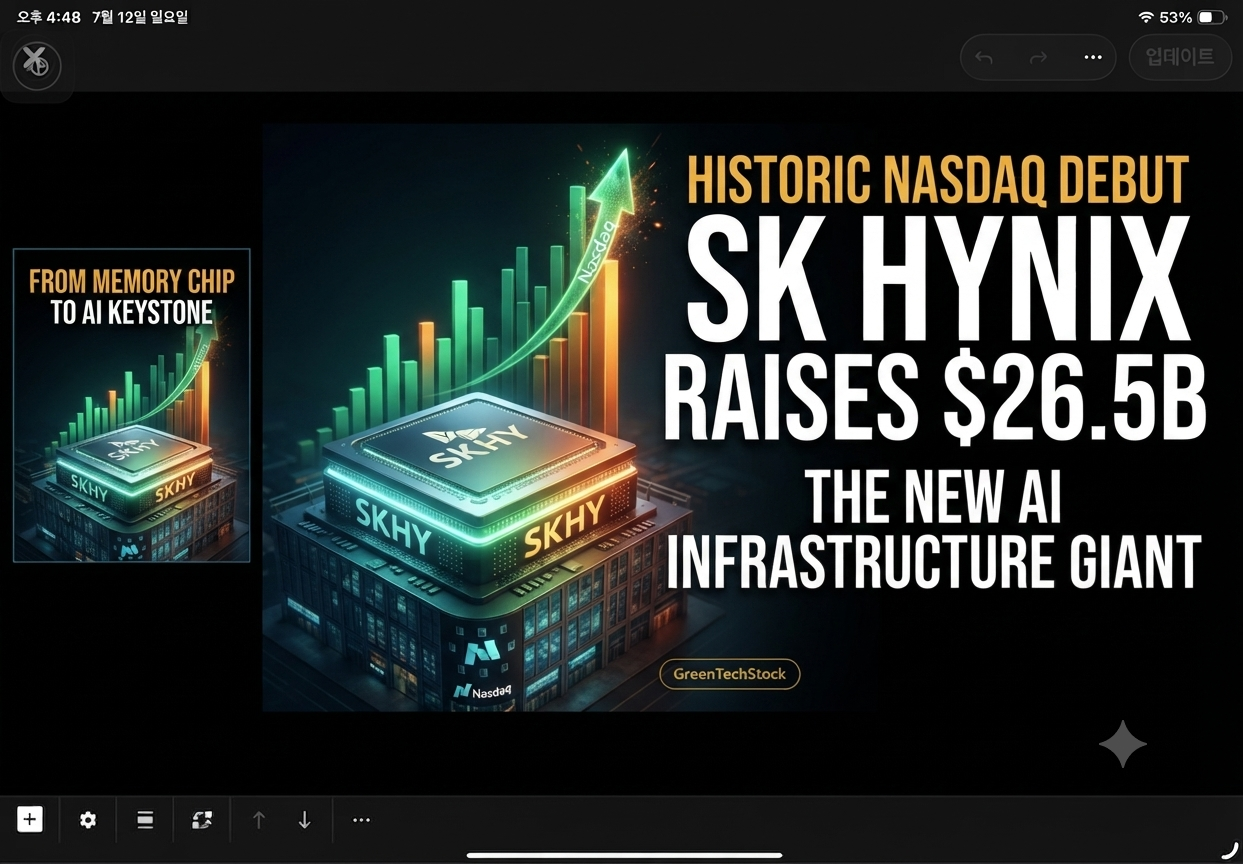
SK hynix officially debuted on Nasdaq under ticker SKHY, raising approximately $26.5 billion through its ADR offering. Here’s what the historic listing means for AI memory, HBM leadership, investors, and the future of the semiconductor industry.
SK hynix’s Historic Nasdaq Debut: More Than an IPO
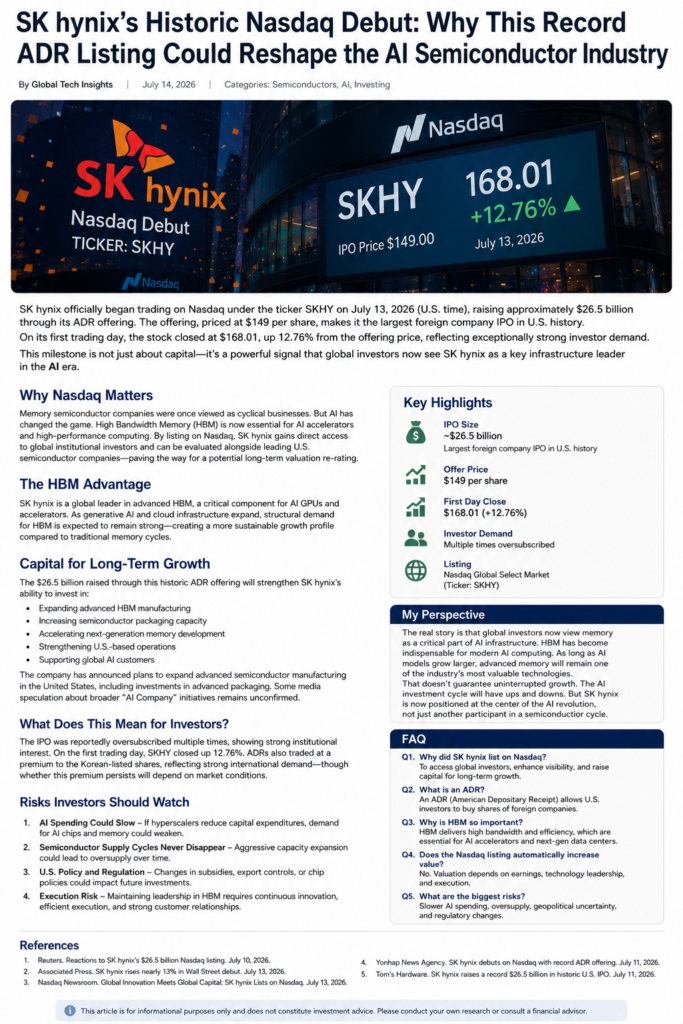
SK hynix officially began trading on the Nasdaq under the ticker SKHY on July 13, 2026 (U.S. time), marking one of the most significant milestones in the company’s history.
The company priced its American Depositary Receipts (ADRs) at $149 per share and raised approximately $26.5 billion, making it the largest foreign company IPO in U.S. history. On its first trading day, the stock closed at $168.01, up 12.76% from the offering price, reflecting exceptionally strong investor demand.
While the numbers alone are impressive, I believe the real significance goes far beyond the amount of capital raised.
This listing represents a shift in how global investors view SK hynix—not simply as a memory chip manufacturer, but as one of the key infrastructure companies powering the AI revolution.
Why Nasdaq Matters
Historically, memory semiconductor companies have been valued as highly cyclical businesses.
Prices rise during supply shortages and fall sharply during oversupply, causing earnings to fluctuate dramatically.
However, artificial intelligence has fundamentally changed this narrative.
Today’s AI accelerators require enormous amounts of High Bandwidth Memory (HBM) to process increasingly complex models.
Without advanced memory, even the world’s most powerful GPUs cannot reach their full performance potential.
This structural change has transformed memory from a commodity product into a strategic AI infrastructure component.
By listing on Nasdaq, SK hynix is now directly visible to global institutional investors who specialize in technology and AI.
Instead of being evaluated primarily within the Korean stock market, the company can now be compared alongside global semiconductor leaders.
This broader investor base could support a long-term valuation re-rating if SK hynix continues to execute successfully.
The HBM Advantage
One of the biggest reasons behind investor enthusiasm is SK hynix’s leadership in the HBM market.
The company has established itself as one of the primary suppliers of advanced HBM products used in AI accelerators.
As generative AI, hyperscale cloud computing, and AI inference continue expanding worldwide, demand for advanced memory is expected to remain strong.
This creates a different growth profile than traditional PC or smartphone memory cycles.
Rather than depending solely on consumer electronics, future growth is increasingly linked to enterprise AI infrastructure.
Capital for Long-Term Growth
The funds raised through the ADR offering provide SK hynix with significant financial flexibility.
Potential investment areas include:
- Expanding advanced HBM manufacturing
- Increasing semiconductor packaging capacity
- Accelerating next-generation memory development
- Strengthening U.S.-based operations
- Supporting global AI customers
The company has already announced plans to expand advanced semiconductor manufacturing in the United States, including investments in advanced packaging.
Some media reports have speculated about broader AI-related organizational initiatives in the U.S., but these remain market expectations rather than officially confirmed corporate plans.
Investors should distinguish between confirmed announcements and industry speculation.
What Does This Mean for Investors?
The first trading day demonstrated exceptionally strong demand.
Reports indicated that the offering attracted multiple times the available allocation, highlighting significant institutional interest.
Another notable development was the temporary price premium between the U.S.-listed ADRs and the Korean-listed common shares.
This suggests that international investors were willing to pay higher prices for direct access through U.S. markets.
Whether this premium persists will depend on future trading activity and market conditions.
Risks Investors Should Watch
Despite the excitement, investors should remain aware of several important risks.
1. AI Spending Could Slow
Current optimism assumes continued expansion of AI infrastructure spending.
If hyperscale cloud providers reduce capital expenditures, semiconductor demand could soften.
2. Semiconductor Supply Cycles Never Disappear
Even with AI-driven demand, memory remains a competitive industry.
Aggressive capacity expansion across the sector could eventually create oversupply.
3. U.S. Policy and Regulation
Government incentives and industrial policies continue to play an important role.
Future changes in subsidy programs, export controls, or semiconductor regulations could influence investment decisions.
4. Execution Risk
Maintaining technological leadership requires continuous innovation.
Future success depends on delivering next-generation HBM products, expanding manufacturing efficiently, and meeting customer demand.
My Perspective
In my opinion, the most important takeaway is not the record-breaking IPO size.
The real story is that global investors increasingly view memory as a critical part of AI infrastructure rather than simply another semiconductor category.
HBM has become indispensable for modern AI computing.
As long as AI models continue becoming larger and more computationally demanding, advanced memory will remain one of the industry’s most valuable technologies.
That does not guarantee uninterrupted growth.
The AI investment cycle will inevitably experience periods of volatility.
However, SK hynix now appears to be positioned at the center of one of the most important long-term technology trends rather than merely participating in another semiconductor upcycle.
For long-term investors, this shift in market perception may ultimately prove more valuable than the IPO itself.
Final Thoughts
SK hynix’s Nasdaq debut is more than a financial milestone.
It reflects a broader transformation occurring across the semiconductor industry.
The company is increasingly recognized as a critical enabler of artificial intelligence, and the ADR listing expands its visibility among global investors.
Although challenges remain—including policy uncertainty, execution risks, and the possibility of slower AI spending—the long-term outlook continues to be supported by structural demand for AI memory.
Whether this listing ultimately becomes a turning point will depend not on the IPO proceeds, but on SK hynix’s ability to maintain technological leadership in High Bandwidth Memory over the coming decade.
Frequently Asked Questions (FAQ)
Why did SK hynix list on Nasdaq?
The company sought greater access to international investors, enhanced global visibility, and additional capital to support long-term growth initiatives.
What is an ADR?
An American Depositary Receipt (ADR) allows investors in the United States to buy shares of foreign companies without trading directly on overseas exchanges.
Why is HBM so important?
HBM provides extremely high memory bandwidth and energy efficiency, making it essential for AI accelerators and next-generation data centers.
Does the Nasdaq listing automatically increase SK hynix’s value?
No.
The listing improves visibility and investor access, but long-term valuation will still depend on earnings growth, technological leadership, and successful execution.
What are the biggest risks?
Key risks include slower AI infrastructure investment, semiconductor oversupply, geopolitical uncertainty, and regulatory changes affecting the global chip industry.
References
- Reuters. Reactions to SK hynix’s $26.5 billion Nasdaq listing. (2026)
- Associated Press. SK hynix rises nearly 13% in Wall Street debut. (2026)
- Nasdaq Newsroom. Global Innovation Meets Global Capital: SK hynix Lists on Nasdaq. (2026)
- Yonhap News Agency. SK hynix debuts on Nasdaq with record ADR offering. (2026)
- Tom’s Hardware. SK hynix raises a record $26.5 billion in historic U.S. IPO. (2026)