Ever wonder why electric vehicles keep squeezing out more range with each new model — or why your phone somehow gets thinner while the battery lasts longer? The answer lies in one key metric: energy density.
In this post, we’ll break down what energy density actually means, how battery makers are pushing it higher, and why chasing bigger numbers isn’t always risk-free.
What Exactly Is Energy Density?
Energy density is usually measured two ways:
- Specific energy (gravimetric energy density): how much energy is stored per unit of weight, measured in Wh/kg
- Volumetric energy density: how much energy is stored per unit of volume, measured in Wh/L
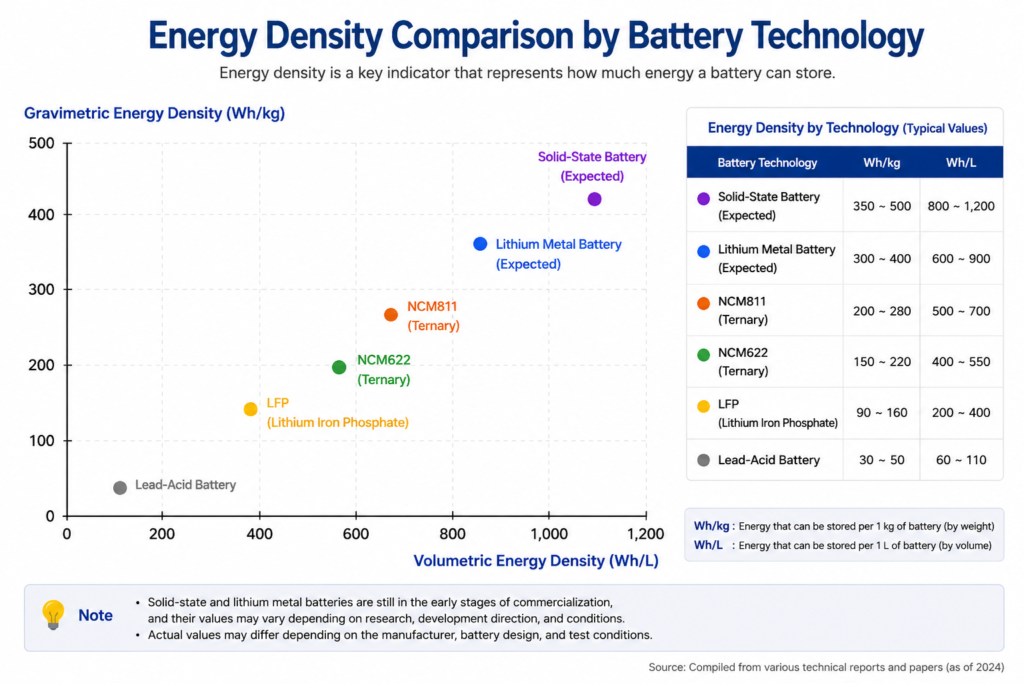
Today’s lithium-ion batteries typically deliver 100–265 Wh/kg and 250–693 Wh/L — a huge jump over older lead-acid or nickel-cadmium batteries.
💡 In plain terms: the higher the energy density, the more power you can pack into a smaller, lighter battery.
Boosting Density Through Materials
High-Nickel Cathodes
NCM (nickel-cobalt-manganese) cathode materials get denser as nickel content rises. An NCM811 cell, for example, outperforms NCM523 or NCM622 in energy density.
The catch: more nickel means a less stable crystal structure and higher surface reactivity, which raises the risk of thermal runaway. It’s a classic engineering trade-off between performance and safety.
Silicon Anodes
Graphite has been the default anode material for years, but silicon is emerging as its successor. Silicon can store far more energy per gram than graphite, meaning manufacturers need less material overall — directly boosting energy density. Some battery material makers are already targeting anode capacities around 2,000 mAh/g for next-generation silicon anodes.
Electrolyte Additives
High-capacity cathodes and anodes need stable interfaces to actually deliver on their potential. Functional electrolyte additives play a quiet but essential role in keeping high-energy-density cells safe and long-lasting.
It’s Not Just Chemistry — Manufacturing Matters Too
- Calendering: After electrode material is coated onto foil, it’s compressed under precise pressure and thickness. This step increases electrode density and is key to maximizing energy density while keeping quality consistent.
- Bigger Form Factors: Tesla’s push toward the 4680 cylindrical cell (46mm diameter, 80mm height) is a good example — scaling up cell size helps offset the inherent limits of cylindrical energy density. The jump from 18650 to 21700 cells alone delivered roughly a 50% increase in capacity.
- Stacking: Pouch-type cells that stack internal layers make more efficient use of internal space, another lever for squeezing out more energy density.
What’s Next? Beyond Lithium-Ion
- Lithium-Sulfur (Li-S) Batteries: Theoretically capable of up to 2,600 Wh/kg, with practical cell-level targets around 500 Wh/kg. This makes Li-S a strong candidate for aerospace applications and long-range EVs.
- Solid-State Batteries: Replacing liquid electrolyte with a solid one improves safety while making it easier to pair with high-energy lithium metal anodes — a big reason solid-state is seen as the next major leap in battery technology.
The Trade-Off Nobody Talks About Enough ⚠️
Here’s the part that often gets glossed over: packing more energy into a smaller space also means packing more risk into that same space. Higher energy density can increase the likelihood of thermal runaway — a chain reaction where internal short-circuiting raises temperature, decomposes the cathode material, releases oxygen, and reacts explosively with flammable gases inside the cell.
That’s why safety innovation has to move in lockstep with energy density gains — think anode technologies that suppress lithium dendrite growth, or flame-retardant additives baked into the cell design.
Quick Recap
| Category | Key Innovations |
|---|---|
| Materials | High-nickel cathodes, silicon anodes |
| Manufacturing | Calendering, larger form factors, stacking |
| Next-Gen Tech | Lithium-sulfur, solid-state batteries |
| Non-Negotiable | Safety engineering alongside every gain |
At the end of the day, the battery industry’s real challenge isn’t just “how much energy can we store” — it’s “how much energy can we store safely.” As next-gen chemistries move from lab to production line, that balance will only get more interesting to watch. 🚀.