Last Updated: July 2026
Disclosure: This article is intended for general educational purposes and reflects publicly available battery science research. It is not professional engineering, medical, or investment advice. Always consult your device or vehicle manufacturer’s guidelines for battery care specific to your product.
What Determines Battery Lifespan? The Science Behind Battery Aging
I’ve spent a good part of my career around chemistry and materials, and one question I still get asked most often — by friends, by readers, by anyone shopping for an EV or worried about their phone battery — is some version of “so when does it actually die?” Whether we’re talking about an electric vehicle, a smartphone, a laptop, or a home energy storage system, every lithium-ion battery has a finite lifespan. But the popular image of a battery suddenly “dying” one day just isn’t how it works. Aging is gradual, and it’s shaped by an interplay of chemistry, temperature, charging habits, and — something I think gets far too little attention — how precisely the cell was actually manufactured.
I want to walk through what’s really happening inside a battery as it ages, the five factors that matter most, and what the latest real-world data actually shows about how long batteries last today.
What Is Battery Lifespan, Exactly?
Before we get into what causes aging, it helps to be precise about what “lifespan” even means, since it’s often used loosely. Engineers generally measure it two ways:
- Calendar life — how long a battery lasts simply due to the passage of time, regardless of use.
- Cycle life — how many full charge-and-discharge cycles a battery can handle before it degrades significantly.
Industry convention typically treats “end of life” as the point where a lithium-ion battery retains around 80% of its original capacity. That’s not a hard cutoff — the battery still works fine at that point — but you’ll usually start noticing a shorter driving range, less runtime between charges, or a subtle drop in performance.
What’s changed recently is how much data we now have on this. A large-scale analysis of over 22,700 real-world EVs, updated in early 2026, put the average annual degradation rate at around 2.3% — meaning a battery would still be expected to retain roughly 80% of its capacity after about eight years of typical use. Vehicles with more modern thermal management tend to do meaningfully better than that average.
How Do Lithium-Ion Batteries Actually Age?
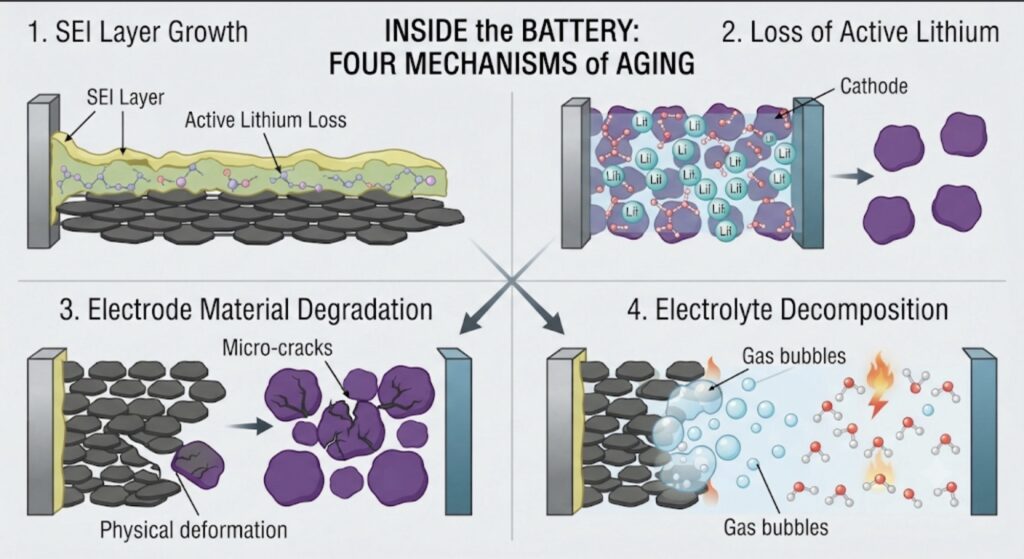
This is the part I find genuinely interesting, even after years of looking at it. Every time a battery charges and discharges, lithium ions shuttle back and forth between the anode and cathode through the electrolyte. That process is never perfectly reversible — small amounts of wear accumulate with every single cycle, invisibly, whether you notice it or not. Four mechanisms account for most of that wear:
SEI layer growth. A thin Solid Electrolyte Interphase (SEI) forms on the graphite anode during a battery’s earliest charge cycles. It protects the anode, but it keeps growing slowly over the battery’s life, consuming active lithium in the process and reducing usable capacity.
Loss of active lithium. As side reactions continue over time, some lithium becomes chemically “stuck” and unavailable for future charge cycles, which shows up as a steady capacity decline.
Electrode material degradation. Electrode particles physically expand and contract with every cycle. Over thousands of cycles, this creates microscopic cracks that reduce conductivity and slow lithium transport.
Electrolyte decomposition. Heat and high voltage speed up electrolyte breakdown, generating gas byproducts and raising internal resistance.
The Five Biggest Factors That Determine Battery Lifespan
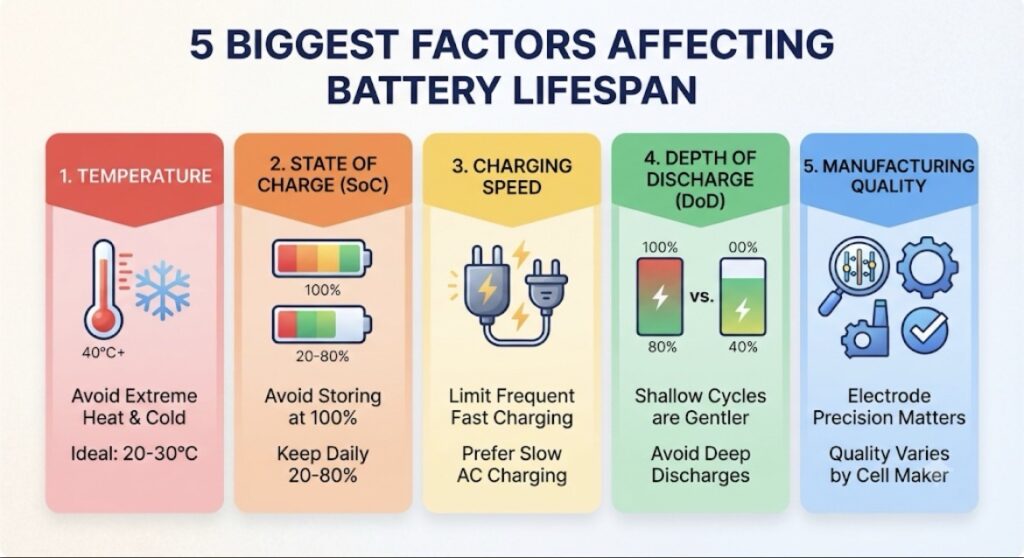
1. Temperature
Temperature is generally considered the single biggest driver of battery aging. Heat accelerates nearly every degradation mechanism described above — faster electrolyte breakdown, thicker SEI growth, and greater internal stress. Extreme cold isn’t harmless either: it slows lithium mobility and can encourage lithium plating during charging, which permanently reduces capacity.
Most lithium-ion cells perform best in a fairly narrow window, roughly 20–30°C, and sustained exposure above 40°C is where degradation tends to accelerate noticeably.
2. State of Charge
Holding a battery at or near 100% for long stretches puts sustained stress on the cathode. Running it down to near 0% repeatedly isn’t ideal either. This is why many EV manufacturers suggest keeping daily charging in a moderate 20–80% range rather than habitually charging to full for everyday use.
3. Charging Speed
Fast charging pushes more current through the cell in less time, which generates more heat and more electrochemical stress. Modern Battery Management Systems (BMS) are designed to limit this damage, but the data backs up what battery engineers have said for years: vehicles that rely heavily on high-power DC fast charging show noticeably higher average degradation than those that mostly charge at lower power levels, particularly in hot climates. My own habit — and what I’d recommend — is to treat fast charging as a convenience for road trips, not a daily routine.
4. Depth of Discharge (DoD)
DoD measures how much of a battery’s capacity gets used in a given cycle — for example, going from 100% to 0% is a 100% DoD cycle, while 80% to 40% is a 40% DoD cycle. Shallower cycles generally place less mechanical stress on the electrodes, which is part of why partial daily charging tends to be gentler on a battery than full deep-discharge cycles.
5. Manufacturing Quality
This is the one I always end up talking about longest, because it’s the factor almost no consumer ever thinks about — and it matters enormously. A battery’s long-term durability is largely decided before it’s ever used, during processes like slurry mixing, electrode coating, drying, calendering, electrolyte filling, and formation.
Manufacturing shortfalls can lead to uneven electrode coatings, particle clustering, microcracking, elevated internal resistance, and localized hot spots — all of which accelerate aging regardless of how carefully the battery is later used. This is a core reason why manufacturing precision has become a genuine competitive differentiator among battery cell producers.
Why Manufacturing Deserves More Attention
It’s tempting — and honestly the more common assumption — to think battery chemistry alone dictates lifespan. In my experience following this industry, manufacturing precision is just as important, if not more so. Uniform slurry mixing improves how evenly active material is distributed. Precise slot-die coating keeps electrode thickness consistent across a cell. Well-controlled calendering increases electrode density without damaging the underlying structure, and proper drying removes residual solvents that would otherwise quietly degrade performance over time.
Two cells built from identical chemistry can age at very different rates depending on how tightly these manufacturing steps were controlled. That’s a big part of why I pay closer attention to a cell maker’s process discipline than to whichever chemistry is trending that year.
Practical Ways to Extend Battery Lifespan
You can’t stop battery aging entirely — I wish I could tell you otherwise — but a handful of habits can meaningfully slow it down. These are the ones I actually follow myself:
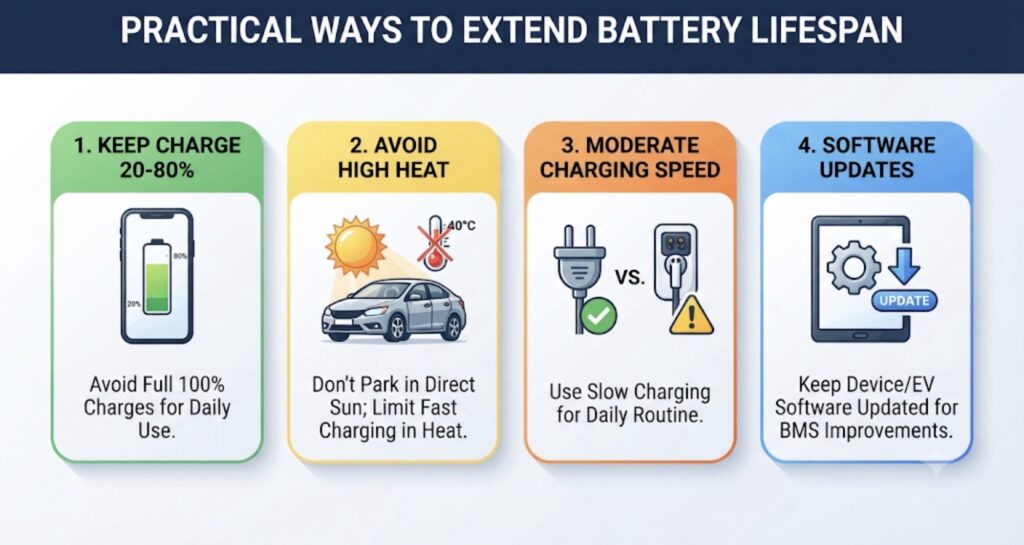
- Avoid leaving a battery fully charged for extended periods.
- Limit exposure to high heat, especially direct sun or hot enclosed spaces.
- Favor standard charging speeds for everyday use; save fast charging for when you actually need it.
- Avoid habitually running a battery down to near-empty.
- Keep device or vehicle software updated, since manufacturers sometimes refine charge-management algorithms.
- For long-term storage, aim for roughly 40–60% charge rather than full or empty.
None of these habits will prevent aging altogether, but together they can noticeably extend how long a battery stays above that ~80% capacity threshold.
My opinion
Battery lifespan gets talked about as if one variable — chemistry, or temperature, or charging habits — explains the whole picture. In my experience, it’s never that simple. It’s the interaction of chemistry, engineering, manufacturing precision, and everyday user behavior that determines how a given cell actually ages.
What I find most encouraging, having watched this space for a while, is how much better the real-world numbers have gotten. The data now shows average EV battery degradation running around 2.3% a year, with newer thermal-management systems doing even better than that. Manufacturing quality still doesn’t get the attention it deserves in consumer conversations, even though a well-designed cell with inconsistent coating or calendering can age faster than a more ordinary chemistry built with tighter process control. As EVs and grid storage scale up, I think that manufacturing precision is becoming just as important a competitive differentiator as chemistry choice itself — and it’s worth watching whether you’re an engineer, an investor, or just someone trying to make their phone battery last a little longer.
Frequently Asked Questions
How long do lithium-ion batteries typically last?
Based on the most recent large-scale EV data, most modern batteries are on track to last somewhere in the range of 15–20 years, with average annual degradation now running around 2.3%. Real-world figures still vary depending on climate, charging habits, and the specific chemistry used.
Is fast charging harmful?
Occasional fast charging is generally fine. The concern is relying on it as your primary charging method day after day, since the added heat and stress compound over time.
Does charging to 100% damage the battery?
An occasional full charge isn’t a problem. The real risk is leaving a battery sitting at 100% for long periods, particularly in a hot environment.
Which single factor affects battery lifespan the most?
Temperature is generally considered the most influential factor, since it accelerates nearly every underlying degradation mechanism at once.
Does battery chemistry matter?
Yes — chemistries like LFP, NCM, and NCA age differently and have different cycle life, thermal stability, and degradation profiles, even under identical usage conditions. LFP cells, for instance, are generally rated for well over 3,000 full cycles, compared to roughly 1,000–1,500 for many NMC cells, though NMC still tends to offer higher energy density.
Related Articles
- Why Electrode Manufacturing Determines Battery Performance
- Slot-Die Coating Defects Explained
- How Calendering Improves Battery Performance
- Understanding Battery Thermal Runaway
- LFP vs NCM Batteries: Which Lasts Longer?