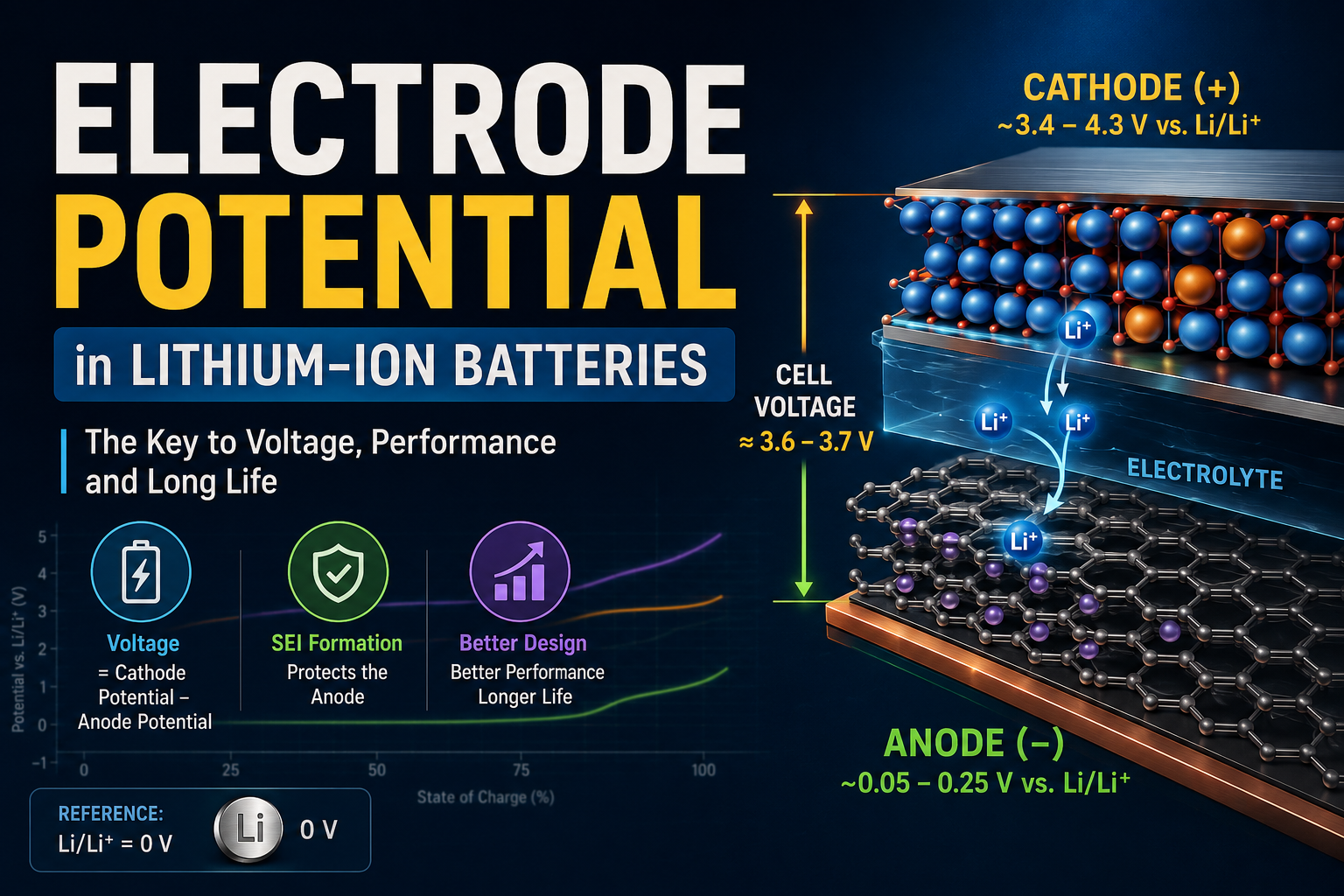
Lithium-ion batteries power everything from smartphones to electric vehicles, yet one of the most fundamental concepts behind how they work — electrode potential — is often skipped over in casual explanations. If you’ve ever seen a data sheet mention “3.7V vs. Li/Li+” and wondered what that actually means, this article breaks it down in plain language, with diagrams to make the concept stick.
What Is Electrode Potential, Really?
When people talk about a lithium-ion cell, they usually mention its voltage — 3.7V, 4.2V, and so on. But voltage is actually the difference between two separate values: the potential of the cathode and the potential of the anode.
Electrode potential describes the energy state of a single electrode relative to a fixed reference point. It tells you how “eager” that electrode is to either give up or accept electrons (and lithium ions) during charging and discharging.
The relationship is simple:
Cell Voltage = Cathode Potential − Anode Potential
So when a cathode material sits at roughly 3.7–3.8V and a graphite anode sits at around 0.1V, the resulting cell voltage lands somewhere around 3.6–3.7V. Neither number alone tells the full story — it’s the gap between them that matters.
The Reference Point: Li/Li+
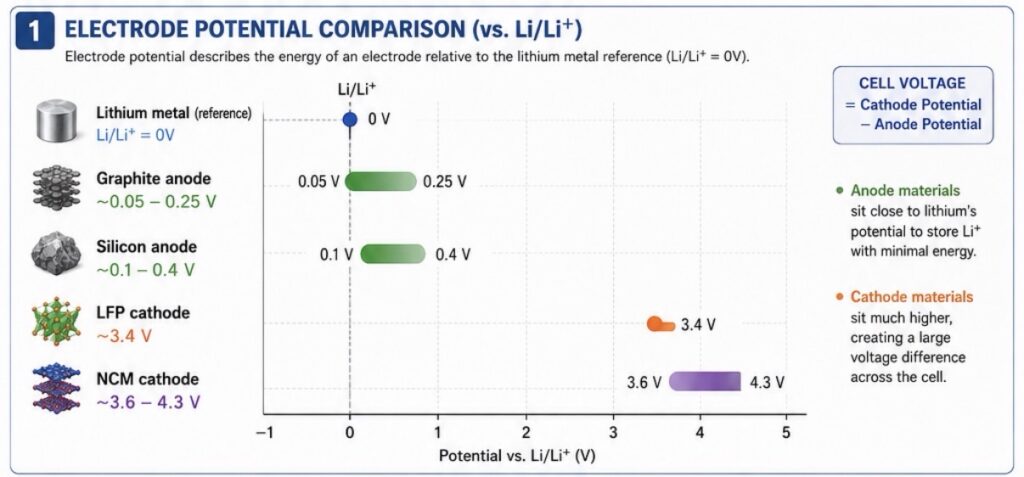
Potential values are meaningless without a reference. In battery chemistry, that reference is almost always lithium metal, denoted as Li/Li+. By convention, lithium metal is assigned a potential of 0V, and every other material’s potential is measured relative to it.
This is why you’ll see values written as “3.4V vs. Li/Li+” in research papers and technical spec sheets — it means the material’s potential was measured against a lithium metal reference electrode.
Here’s how some common electrode materials compare:
- Lithium metal: 0V (reference point)
- Graphite anode: ~0.05–0.25V
- Silicon anode: ~0.1–0.4V
- LFP (Lithium Iron Phosphate) cathode: ~3.4V
- NCM (Nickel Cobalt Manganese) cathode: ~3.6–4.3V, depending on state of charge
Notice that anode materials sit close to lithium’s own potential — that’s intentional, since anodes are designed to store lithium ions with minimal energy cost. Cathode materials, on the other hand, sit much higher, which is exactly what creates a large voltage difference across the cell.
Why Potential Changes During Charging and Discharging
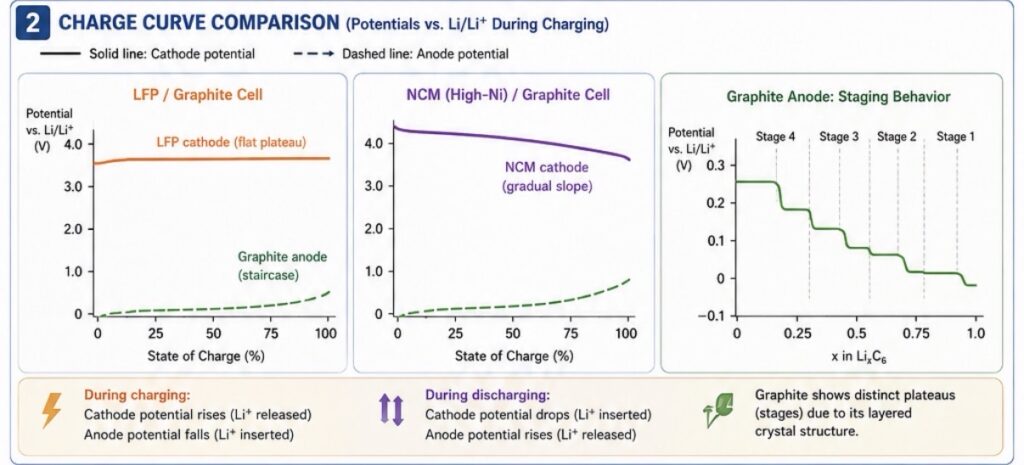
Electrode potential isn’t static — it shifts constantly as lithium ions move in and out of the electrode structure. This happens because the internal energy state of the material changes as it becomes more or less “lithiated” (filled with lithium).
- During charging: the cathode releases lithium ions and its potential rises; the anode absorbs lithium ions and its potential falls.
- During discharging: the opposite happens — cathode potential drops, anode potential rises.
Different cathode chemistries behave quite differently here. LFP tends to maintain a nearly flat, plateau-like voltage throughout most of the charge cycle, which is one reason it’s prized for stable, predictable power delivery. NCM, by contrast, shows a more gradual, continuously sloping potential curve as lithium content changes — useful for gauging state of charge, but slightly less flat in output.
Graphite anodes show a “staircase” pattern with several distinct plateaus, each corresponding to a different stage of lithium intercalation between graphite layers. This staged behavior is a direct consequence of graphite’s layered crystal structure.
The Electrochemical Window — and Why It Matters
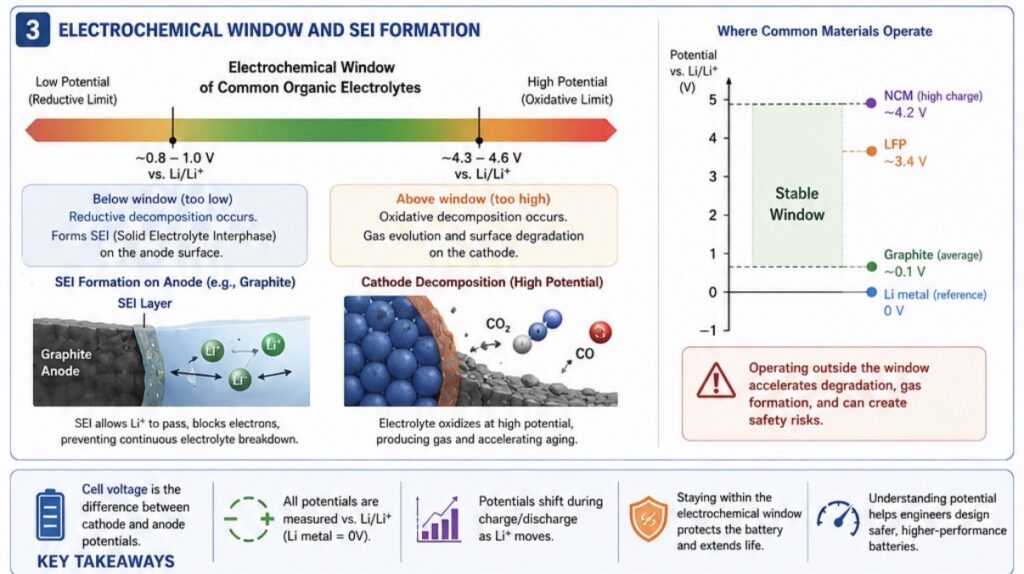
Every electrolyte has a range of potentials it can tolerate without breaking down. This range is called the electrochemical window. If an electrode’s potential strays outside that window, the electrolyte starts to decompose — and that’s where a lot of battery degradation begins.
- If potential drops too low (on the anode side), the electrolyte undergoes reductive decomposition, forming a passivation layer known as the SEI (Solid Electrolyte Interphase).
- If potential rises too high (on the cathode side), the electrolyte undergoes oxidative decomposition, often producing gas and accelerating capacity fade.
Graphite anodes typically operate at around 0.1V vs. Li/Li+ — a potential that falls below the stable window of most conventional organic electrolytes. As a result, during the very first charge cycle, a small amount of electrolyte decomposes and forms the SEI layer on the graphite surface.
This might sound like a flaw, but it’s actually a feature: once formed, the SEI layer acts as a protective barrier. It allows lithium ions to pass through while blocking further electron transfer, effectively stopping continuous electrolyte breakdown. Without a stable SEI, a battery would keep consuming electrolyte and lithium inventory with every cycle, leading to rapid capacity loss.
On the cathode side, high-nickel materials like NCM operate close to the upper edge of the electrolyte’s stability window, which is part of why high-voltage cathodes tend to generate more gas and degrade faster at elevated charge voltages — a key challenge for battery engineers pushing toward higher energy density.
Why This Matters for Battery Design
Understanding electrode potential isn’t just academic — it directly informs practical engineering decisions:
- Material selection: Choosing a cathode or anode material means understanding where its potential sits relative to the electrolyte’s stable window.
- Electrolyte formulation: Additives are often engineered specifically to widen the stable potential range or to build a more robust SEI layer.
- Cycle life and safety: Operating an electrode too far outside its ideal potential range accelerates degradation and, in extreme cases, can create safety risks like gas buildup or thermal instability.
- Fast charging: Aggressive charging protocols can push anode potential dangerously close to 0V, risking lithium plating instead of proper intercalation — a major concern for extreme fast-charging designs.
Final Thoughts
At its core, electrode potential describes how much energy an electrode holds relative to a lithium metal reference — and the difference between cathode and anode potential is what gives a lithium-ion cell its voltage. This single concept ties together material selection, electrolyte stability, SEI formation, and long-term battery performance.
Next time you see “vs. Li/Li+” on a battery spec sheet, you’ll know exactly what it means — and why it matters for everything from your phone’s battery life to the range of an electric vehicle.