When people discuss lithium-ion battery manufacturing, conversations usually revolve around new materials—solid-state batteries, silicon anodes, or high-nickel cathodes.
In my view, however, one of the most underrated technologies isn’t a new material at all.
It’s how the electrode is dried.
Drying may sound like a simple process of removing solvent, but battery engineers know that it is one of the most influential steps in determining long-term cell performance.
A poorly controlled drying process can permanently damage an otherwise excellent electrode.
Why Drying Is More Difficult Than It Looks
After slurry is coated onto the current collector, the solvent must evaporate inside a drying oven.
At first glance, it seems logical that drying faster would improve factory productivity.
Unfortunately, batteries don’t work that way.
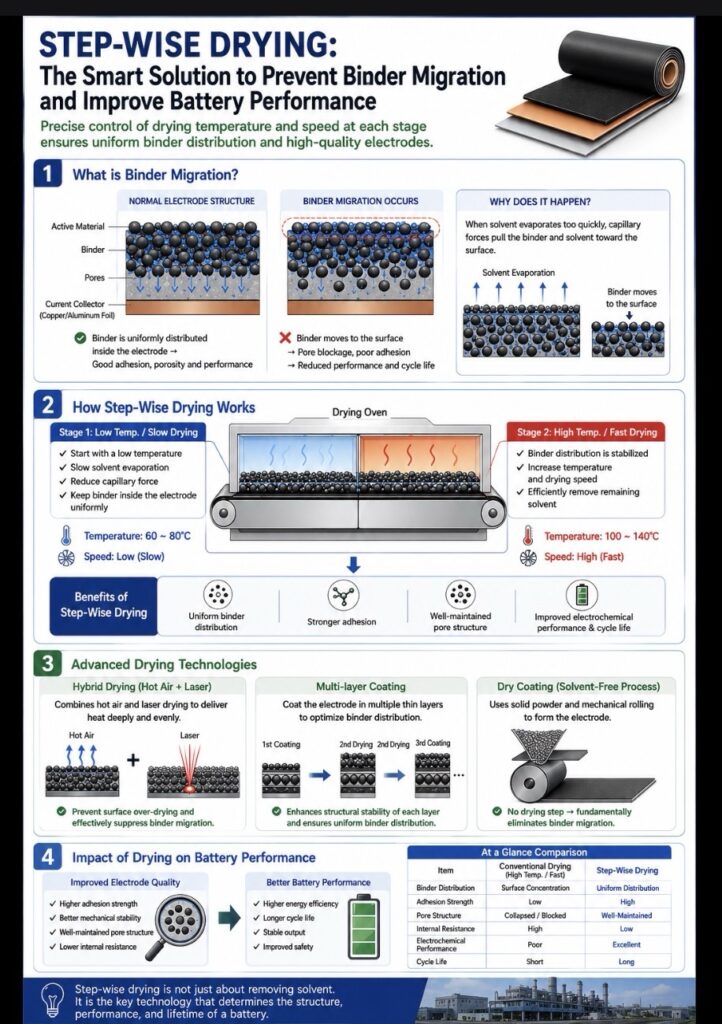
If the solvent evaporates too quickly, the binder begins moving with the solvent toward the electrode surface.
This phenomenon is called Binder Migration.
Instead of remaining uniformly distributed throughout the electrode, the binder becomes concentrated near the top surface.
Although the electrode may still look perfectly normal, its internal structure has already changed.
Why Binder Migration Is Such a Serious Problem
The binder has one critical responsibility:
It holds active materials together while firmly attaching the coating to the current collector.
When too much binder migrates upward, two problems appear simultaneously.
First, the surface becomes overloaded with binder.
This can reduce electrode porosity, making it more difficult for lithium ions to move efficiently.
Second, the region near the aluminum or copper current collector becomes deficient in binder.
As a result, adhesion strength decreases significantly.
Over thousands of charging cycles, this seemingly small imbalance can contribute to:
- Capacity loss
- Higher internal resistance
- Mechanical degradation
- Poor cycle life
- Lower manufacturing yield
This is why battery manufacturers pay so much attention to drying profiles.
The Smart Solution: Step-Wise Drying
Rather than exposing freshly coated electrodes to high temperatures immediately, manufacturers increasingly use Step-Wise Drying.
Instead of one aggressive drying stage, the process is divided into multiple carefully controlled zones.
Stage 1: Low Temperature, Slow Drying
The first drying zone intentionally operates at relatively low temperatures.
This slows solvent evaporation during the most sensitive stage.
More importantly, it reduces the capillary forces generated as solvent escapes from the coating.
Lower capillary force means the binder is much less likely to migrate toward the surface.
The goal is not to dry the electrode quickly.
The goal is to stabilize the binder distribution before accelerating evaporation.
Stage 2: High Temperature, Fast Drying
Once the binder distribution becomes relatively stable, the process shifts to higher temperatures.
At this point, remaining solvent can be removed efficiently without causing significant binder migration.
The electrode reaches its target moisture level while maintaining a much more uniform internal structure.
This two-stage approach balances manufacturing speed with electrode quality.
My Perspective: Faster Isn’t Always Better
One lesson repeatedly seen in battery manufacturing is that higher production speed does not automatically create better batteries.
Factories naturally want to maximize throughput.
Higher line speeds reduce manufacturing cost.
Higher oven temperatures shorten drying time.
Everything appears more efficient.
But battery manufacturing is filled with trade-offs.
In my opinion, drying is one of the clearest examples where process optimization matters more than simple speed.
An extra few minutes spent achieving uniform binder distribution may ultimately improve battery lifetime far more than increasing production speed.
Sometimes slowing down one process is actually the fastest way to improve overall manufacturing efficiency because fewer defective electrodes are produced.
Hybrid Drying Is Becoming the Next Evolution
Step-Wise Drying is already highly effective.
However, manufacturers continue searching for even better solutions.
One promising approach combines conventional hot-air drying with laser-assisted heating.
Unlike hot air, which primarily heats the surface first, laser energy can deliver heat deeper into the electrode coating.
This creates a more uniform drying profile while further reducing binder migration.
As battery factories continue increasing coating thickness for higher energy density, hybrid drying technologies may become increasingly important.
Multi-Layer Coating Offers Another Approach
Another strategy is Multi-Layer Coating.
Instead of applying one thick coating layer, manufacturers deposit several thinner layers.
Each layer can be partially dried before the next coating is applied.
This approach improves binder distribution throughout the electrode while reducing internal drying stress.
Although the manufacturing process becomes more complex, the resulting electrode quality can improve significantly.
Could Dry Electrode Manufacturing Eliminate the Problem Completely?
Perhaps the most exciting innovation is Dry Electrode Manufacturing.
Unlike conventional slurry coating, dry electrode technology does not use liquid solvent.
Without solvent, there is no drying process.
Without drying, there is essentially no binder migration.
This is one reason why many battery companies view dry electrode technology as a potential game changer.
Beyond solving binder migration, dry manufacturing also offers:
- Lower factory energy consumption
- Reduced carbon emissions
- Smaller production equipment
- Lower operating costs
- Simpler manufacturing flow
Commercialization still presents engineering challenges, but the long-term potential is enormous.
Final Thoughts
Battery innovation is often associated with breakthrough chemistries.
Yet many of the industry’s biggest improvements come from manufacturing technology rather than new materials.
Step-Wise Drying is an excellent example.
By carefully controlling drying temperature and speed instead of maximizing production rate, manufacturers can create electrodes with stronger adhesion, more uniform internal structure, and longer-lasting battery performance.
From my perspective, this is exactly what makes battery manufacturing so fascinating.
Sometimes the most important innovations are not dramatic inventions—but smarter ways of controlling processes that already exist.
As battery technology continues evolving, process engineering will remain just as critical as material science.
Sources
- Efficiency and Innovation in Battery Drying Processes
Government of Korea, Joint Ministries (2021). K-Battery Industry Development Strategy 2030. - Interfacial Stability and Electrode Protection Mechanisms in Advanced Batteries
KAIST News Office (2026). Solving the commercialization challenges of lithium-metal batteries. - Manufacturing Process Compatibility for Next-Generation Lithium Batteries
LG Energy Solution (2024). Lithium-metal batteries: next-generation energy density breakthrough. Battery Insight. - Advanced Processing Techniques for Solid-State and High-Density Electrodes
Wikipedia contributors (2026). Solid-state battery. - Structural Engineering Strategies for Mechanical Stability in Electrodes
Seo, J.H., Kim, D.K., & Park, M.S. (2023). Technical challenges and research strategies for next-generation lithium-metal anodes. Ceramist, 26(2), 265–279.