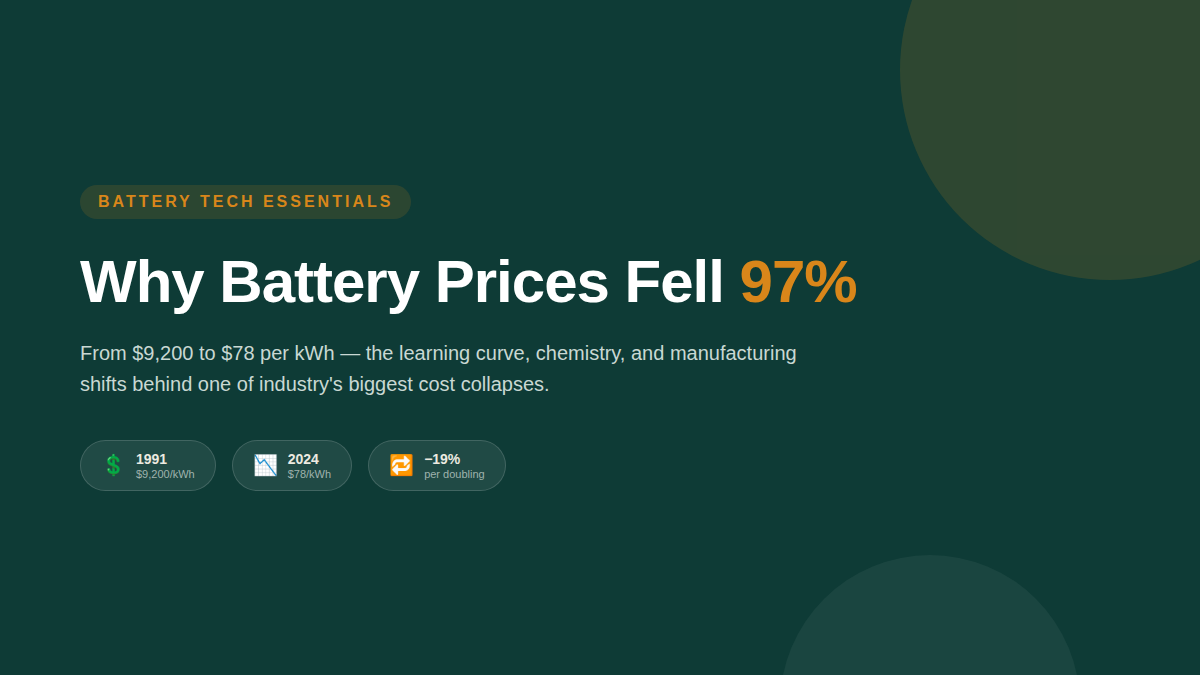
Discover why lithium-ion battery prices dropped by more than 97% since 1991. Learn how energy density, economies of scale, manufacturing innovation, and new battery chemistries transformed the global battery industry.
Why Lithium-Ion Battery Prices Fell by More Than 97%
If someone had predicted in the early 1990s that lithium-ion battery prices would fall by more than 97%, very few people would have believed it.
Back then, rechargeable lithium-ion batteries were considered premium technology. They powered only a limited number of electronic devices because they were simply too expensive for mass adoption.
Today, however, lithium-ion batteries have become the foundation of electric vehicles, renewable energy storage, smartphones, laptops, and even AI data centers.
So what happened?
In my view, the dramatic decline in battery prices wasn’t driven by a single breakthrough. Instead, it resulted from decades of continuous innovation, manufacturing improvements, and rapidly expanding global demand.
Let’s explore the key reasons behind one of the greatest cost reductions in modern industrial history.
The Numbers Tell an Incredible Story
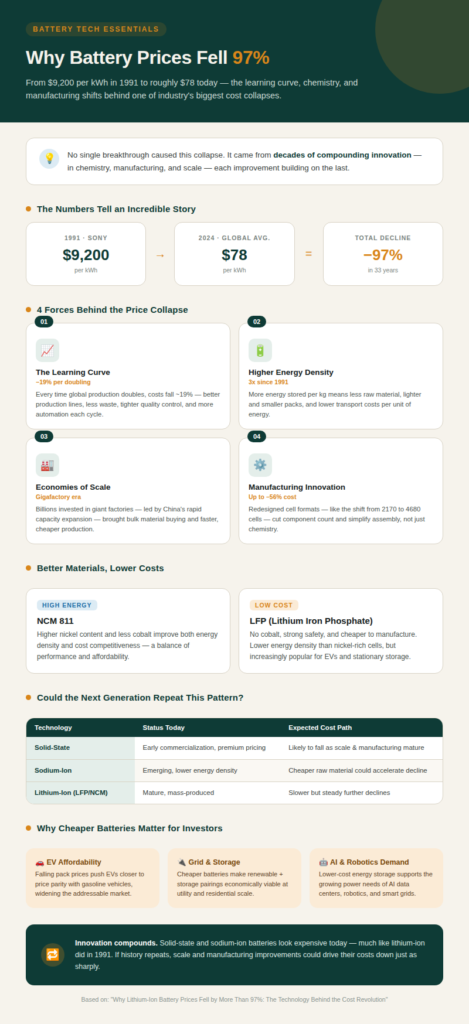
When Sony commercialized the first lithium-ion battery in 1991, battery costs were estimated at around $9,200 per kilowatt-hour (kWh).
Fast forward to 2024, and average battery pack prices have fallen to approximately $78 per kWh.
That represents a price decline of roughly 97%.
This extraordinary cost reduction has completely changed industries that once relied on fossil fuels.
Without cheaper batteries, electric vehicles would still be luxury products rather than becoming mainstream transportation.
Learning by Doing: The Battery Learning Curve
One of the biggest drivers of falling battery prices is something economists call the learning curve.
For lithium-ion batteries, researchers have observed that every time global production capacity doubles, battery costs fall by roughly 19%.
Why does this happen?
As manufacturers produce more batteries, they gain experience that leads to:
- More efficient production lines
- Lower manufacturing waste
- Better quality control
- Faster assembly processes
- Improved automation
Personally, I think this is one of the most fascinating aspects of manufacturing. Companies don’t just become larger—they become smarter. Every generation of batteries teaches engineers how to build the next generation more efficiently.
Higher Energy Density Changed Everything
Another major reason for lower battery prices is the rapid improvement in energy density.
Since 1991, lithium-ion battery energy density has increased by more than three times.
This means modern batteries can store far more energy within the same size and weight.
Higher energy density creates multiple cost advantages:
- Less raw material is needed per unit of energy.
- Battery packs become lighter and smaller.
- Manufacturing becomes more efficient.
- Transportation costs decrease.
In my opinion, increasing energy density has arguably been the single most important technological achievement in lithium-ion battery development.
Instead of simply making batteries cheaper, engineers made them significantly better.
Economies of Scale Reduced Manufacturing Costs
Technology alone cannot explain such a dramatic price decline.
Mass production played an equally important role.
As demand for electric vehicles and consumer electronics surged, battery manufacturers invested billions of dollars in large-scale factories.
Countries such as China dramatically expanded global battery production capacity.
Larger factories brought significant benefits:
- Lower production costs
- Bulk purchasing of raw materials
- Improved supply chain efficiency
- Higher production speed
This classic example of economies of scale allowed manufacturers to reduce costs while increasing output.
Manufacturing Innovation and R&D
Battery companies also invested heavily in research and development.
Rather than simply improving battery chemistry, engineers redesigned the manufacturing process itself.
One example is the shift toward larger battery cells, such as moving from the 2170 cell to the 4680 cell.
Larger cells can:
- Reduce the number of individual components
- Simplify manufacturing
- Improve structural efficiency
- Lower production costs
Some estimates suggest these manufacturing innovations could reduce production costs by up to 56%.
From my perspective, battery innovation is no longer just about chemistry. Manufacturing technology has become just as important as the battery materials themselves.
Better Materials Lowered Costs
Battery chemistry has also evolved significantly.
Manufacturers have gradually reduced reliance on expensive materials such as cobalt.
For example:
NCM 811
Increasing nickel content while reducing cobalt improved both energy density and cost competitiveness.
LFP (Lithium Iron Phosphate)
LFP batteries use no cobalt, offer excellent safety, and are generally cheaper to manufacture.
Although they have lower energy density than some nickel-rich batteries, their lower cost has made them increasingly popular for electric vehicles and stationary energy storage systems.
Today, many automakers use multiple battery chemistries depending on vehicle type and market requirements.
Why This Matters for the Future
Lower battery prices have done far more than reduce manufacturing costs.
They have accelerated the global transition toward:
- Electric vehicles
- Renewable energy
- Residential energy storage
- AI infrastructure
- Robotics
- Smart grids
As batteries become more affordable, entirely new industries become economically viable.
Personally, I believe the next decade may repeat this pattern.
Solid-state batteries, sodium-ion batteries, and other next-generation technologies may initially appear expensive. However, if history repeats itself, costs are likely to decline rapidly as production scales and manufacturing improves.
Frequently Asked Questions
Why have lithium-ion battery prices fallen so much?
The biggest reasons include higher energy density, manufacturing improvements, economies of scale, material innovation, and decades of research and development.
What is the battery learning curve?
The battery learning curve describes how production costs decrease as manufacturers gain experience. For lithium-ion batteries, costs have historically fallen by about 19% every time cumulative production doubled.
Why is energy density important?
Higher energy density allows batteries to store more energy using fewer materials, reducing both manufacturing costs and battery size.
Will battery prices continue to fall?
Most analysts expect further declines as manufacturing expands and new technologies such as solid-state and sodium-ion batteries mature, although raw material prices and market conditions will continue to influence overall costs.
Real-World Example:China’s Gigafactory Effect
A good example is China’s battery manufacturing expansion during the 2010s. As companies such as CATL and BYD built massive production facilities, equipment utilization improved dramatically and suppliers moved closer to manufacturing hubs.
This reduced logistices costs, improved supply chain efficiency, and accelerated learning across the entire battery ecosystem.
In many cases, cost reductions came not form better chemistry but from building the same battery more efficiently.
Final Thoughts
The 97% decline in lithium-ion battery prices is one of the most remarkable examples of technological progress in modern history.
It wasn’t caused by a single invention or one revolutionary discovery. Instead, it resulted from decades of continuous improvements in battery chemistry, manufacturing efficiency, production scale, and engineering expertise.
As someone who closely follows the battery industry, I find this trend particularly exciting because it demonstrates how innovation compounds over time. Each improvement builds upon the last, making technologies that once seemed prohibitively expensive accessible to millions of people.
If history is any guide, today’s emerging battery technologies may follow the same path—starting as premium innovations before eventually becoming part of everyday life.