When people hear about dry electrode manufacturing, the first benefit they usually mention is environmental sustainability.
It eliminates toxic solvents, reduces factory energy consumption, and simplifies production.
While all of those advantages are true, I believe the biggest reason the battery industry is investing so heavily in dry electrode technology is something else.
Dry electrodes make thicker electrodes possible.
And thicker electrodes may become one of the most important ways to increase battery energy density in the coming generation of lithium-ion batteries.
Why Does Electrode Thickness Matter?
Every battery stores energy inside its active materials.
The more active material contained within each electrode, the more energy the battery can potentially store.
This sounds simple.
Just make the electrode thicker.
Unfortunately, conventional wet manufacturing makes this surprisingly difficult.
The Hidden Limitation of Wet Electrode Manufacturing
Traditional lithium-ion batteries are produced using a slurry made from:
- Active materials
- Conductive additives
- Binder
- Liquid solvent
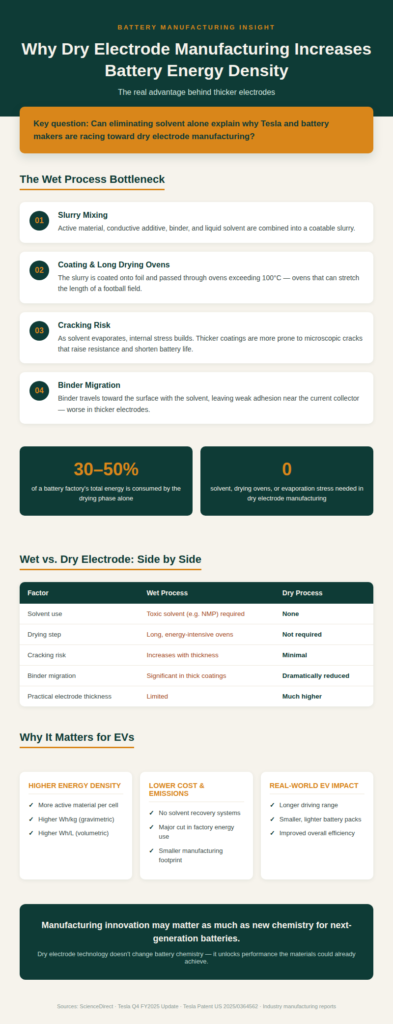
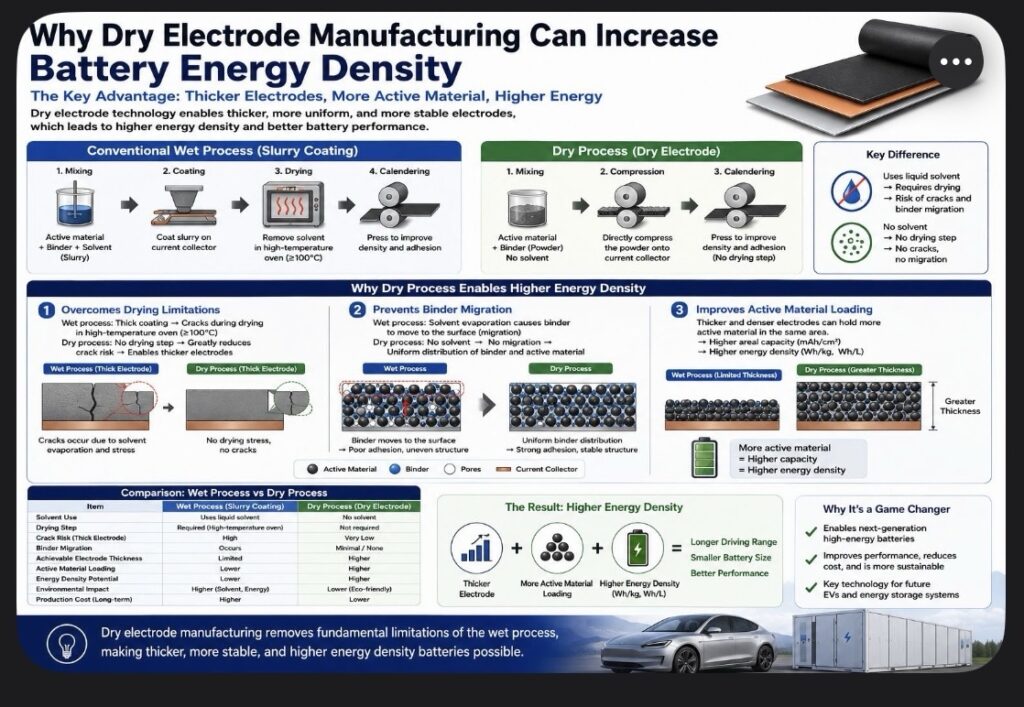
After coating, the electrode passes through a long drying oven where the solvent evaporates.
This drying step creates several manufacturing challenges.
As coating thickness increases, drying becomes increasingly difficult.
The thicker the electrode, the harder it becomes to maintain a stable internal structure.
Thick Wet Electrodes Often Develop Cracks
One major problem is cracking.
When thick electrodes are exposed to drying temperatures that often exceed 100°C, solvent evaporation generates internal stress throughout the coating.
As the solvent escapes, shrinkage occurs.
If this stress becomes too large, microscopic cracks begin forming inside the electrode.
Even tiny cracks can reduce mechanical strength, increase electrical resistance, and shorten battery life.
This is one reason why conventional wet manufacturing places practical limits on electrode thickness.
Binder Migration Becomes Even Worse
Another problem grows as electrodes become thicker.
During drying, solvent naturally moves toward the electrode surface.
The binder travels with it.
This phenomenon, known as Binder Migration, becomes more severe in thicker coatings because solvent must travel a much longer distance before completely evaporating.
The result is an uneven internal structure.
The surface accumulates excessive binder while the region near the current collector loses adhesion strength.
Instead of improving battery performance, a thicker wet electrode may actually create more manufacturing defects.
Dry Electrode Manufacturing Removes Both Problems
Dry electrode manufacturing changes the process completely.
Instead of creating a liquid slurry, manufacturers mix dry powders and mechanically compress them into electrodes.
No solvent is used.
Because there is no solvent:
- No drying ovens are required.
- No drying stress develops.
- No solvent evaporation occurs.
- Binder migration is dramatically reduced.
This allows manufacturers to design much thicker electrodes while maintaining a much more uniform internal structure.
More Active Material Means Higher Energy Density
The biggest advantage appears here.
Since thicker electrodes become practical, manufacturers can pack more active material into the same footprint.
Imagine two battery cells with identical dimensions.
If one electrode safely contains more active material, it can store more energy without increasing battery size.
This directly improves:
- Gravimetric energy density (Wh/kg)
- Volumetric energy density (Wh/L)
For electric vehicles, this could mean:
- Longer driving range
- Smaller battery packs
- Lower system weight
- Improved overall efficiency
My Perspective: Manufacturing Is Becoming the New Battery Innovation
Many people still think battery breakthroughs come only from discovering new materials.
I see manufacturing technology becoming equally important.
Dry electrode manufacturing doesn’t change battery chemistry.
Instead, it unlocks performance that today’s materials could not fully achieve using conventional production methods.
Sometimes better manufacturing creates just as much value as better chemistry.
This is one reason companies around the world are investing billions into dry electrode development.
Challenges Still Remain
Although dry electrode manufacturing offers enormous potential, commercialization is not simple.
Several engineering challenges remain, including:
- Achieving uniform powder dispersion
- Maintaining electrode mechanical strength
- Scaling production to gigafactory levels
- Ensuring consistent product quality at high speeds
These issues explain why widespread adoption is taking time despite the technology’s obvious advantages.
Why the Industry Calls It a Game Changer
Dry electrode technology offers multiple benefits simultaneously:
- Higher energy density
- Thicker electrode capability
- Lower factory energy consumption
- Reduced carbon emissions
- Simpler manufacturing flow
- Lower operating costs
- Improved sustainability
Very few manufacturing technologies improve battery performance, production efficiency, and environmental impact at the same time.
That is why many experts consider dry electrode manufacturing one of the most important battery manufacturing innovations of the decade.
Final Thoughts
The future of batteries will not depend solely on discovering new cathode or anode materials.
Equally important will be finding better ways to manufacture them.
Dry electrode technology demonstrates exactly how process innovation can unlock higher energy density without fundamentally changing battery chemistry.
In my opinion, this is why dry electrode manufacturing deserves so much attention.
The real breakthrough isn’t simply eliminating solvent.
It’s enabling thicker, stronger, and more energy-dense electrodes that were previously difficult to manufacture using conventional wet processes.
As battery manufacturers continue pushing for longer EV range and lower production costs, dry electrode manufacturing could become one of the defining technologies of next-generation battery production.
Sources
- Research papers on dry electrode manufacturing
- Studies on thick electrode design for lithium-ion batteries
- Academic literature on binder migration and drying-induced cracking
- Industry reports covering next-generation battery manufacturing technologies
- Publications on energy density optimization through electrode engineering
Sources
- ScienceDirect: dry electrode manufacturing review covering economic, environmental, and performance comparisons vs. slurry-process electrodes
- Tesla Q4 & Fiscal Year 2025 Update Letter — confirmation of dry electrode process for both anode and cathode in 4680 cells
- U.S. Patent US 2025/0364562 (published Nov. 27, 2025) — Tesla’s fully dry cathode fabrication process
- Industry manufacturing analyses on wet vs. dry electrode production economics