The commercial satellite industry is no longer just about launching satellites into orbit. Today, the real competition lies in how quickly, how often, and how accurately companies can deliver actionable Earth observation data.
Among the leading players, Planet Labs (PL), BlackSky, and Maxar have each established unique strengths, making them complementary rather than direct substitutes.
If NVIDIA became the leader in AI chips, these companies are competing to become the essential data infrastructure of the Earth.
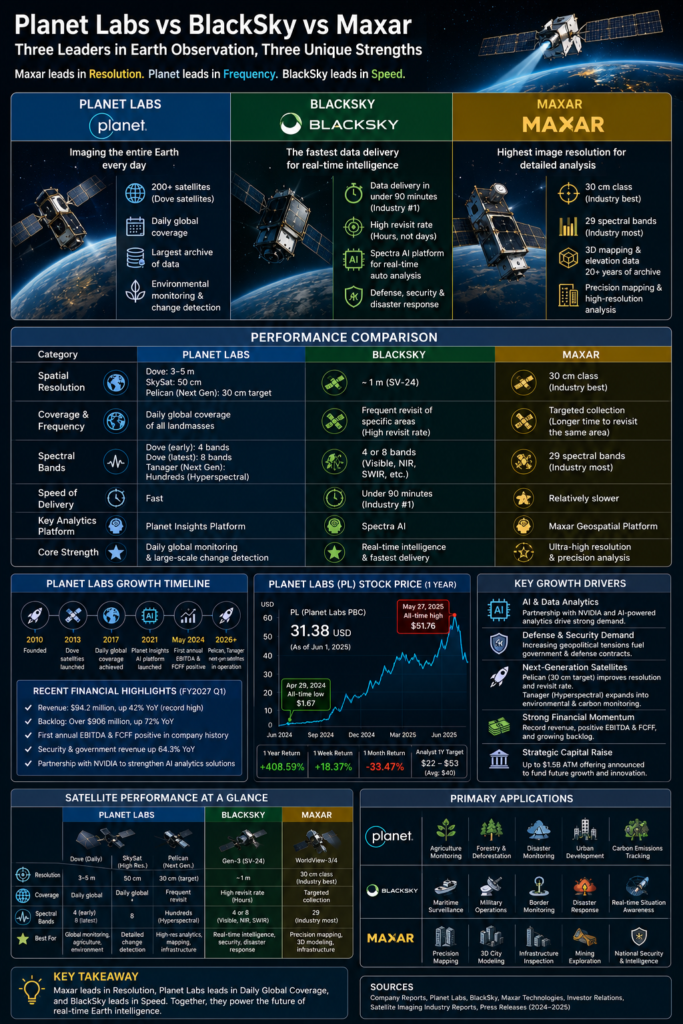
Three Different Approaches to Earth Observation
Company
Biggest Strength
Best Use Case
Planet Labs
Daily global coverage
Environmental monitoring, agriculture, AI analytics
BlackSky
Fastest data delivery
Military intelligence, disaster response
Maxar
Highest image resolution
Precision mapping, infrastructure analysis
Instead of competing on exactly the same product, each company dominates a different segment of the satellite imaging market.
1. Maxar: The Leader in Image Quality
Maxar operates some of the world’s most advanced high-resolution imaging satellites.
Its flagship satellites deliver 30-centimeter spatial resolution, allowing analysts to identify extremely fine details, including vehicles and infrastructure changes.
Key Advantages
- 30 cm ultra-high-resolution imagery
- Industry-leading multispectral sensors
- Extensive 3D mapping database
- Decades of historical satellite archives
Because of these capabilities, Maxar is widely used by:
- Defense agencies
- National mapping organizations
- Infrastructure developers
- Intelligence services
If precision matters most, Maxar remains the benchmark.
2. Planet Labs: Watching the Entire Earth Every Day
Planet Labs took a completely different approach.
Instead of building a few expensive satellites, Planet launched more than 200 small satellites, enabling daily imaging of nearly every landmass on Earth.
Its competitive advantage is not the sharpest image—it is the largest and most frequently updated Earth dataset ever created.
Why This Matters
Daily imagery allows organizations to monitor:
- Crop growth
- Wildfires
- Floods
- Deforestation
- Construction activity
- Mining operations
- Supply chains
- Geopolitical developments
Rather than asking “What happened?”, Planet helps customers answer:
“What changed today?”
This daily change detection has become increasingly valuable for governments and enterprise customers.
3. BlackSky: The Fastest Intelligence Platform
BlackSky focuses on speed.
Its constellation can revisit important locations multiple times per day, and the company specializes in rapid tasking for customers needing immediate intelligence.
One of BlackSky’s biggest competitive advantages is delivery speed.
Satellite imagery can often be delivered in less than 90 minutes after collection.
That capability makes BlackSky particularly valuable for:
- Military operations
- Border monitoring
- Maritime surveillance
- Emergency response
- Natural disasters
The company’s Spectra AI platform automatically detects changes such as:
- Ship movement
- Aircraft activity
- Vehicle traffic
- Construction progress
Rather than simply providing images, BlackSky delivers real-time situational awareness.
Resolution Comparison
Company
Image Resolution
Maxar
30 cm
Planet SkySat
50 cm
Planet Dove
3–5 m
BlackSky
About 1 m
Higher resolution provides more detail, but also increases costs and limits global coverage.
Coverage Comparison
Company
Coverage Strategy
Planet
Entire Earth every day
BlackSky
Frequent revisit of selected locations
Maxar
Targeted ultra-high-resolution imaging
Each company optimized a different business model.
Speed Comparison
Company
Data Delivery
BlackSky
Under 90 minutes
Planet
Fast
Maxar
Traditional delivery
For defense customers, speed can be more valuable than image quality.
Planet Labs’ Strong Financial Momentum
Beyond technology, Planet Labs has become one of the most closely watched space stocks thanks to its improving financial performance.
Record Revenue
Fiscal Q1 2027 revenue reached approximately $94.2 million, representing 42% year-over-year growth.
The company also achieved:
- Record quarterly revenue
- First positive EBITDA
- Positive free cash flow
- Backlog exceeding $906 million
These milestones suggest Planet has moved beyond the early-stage startup phase toward sustainable commercial growth.
Stock Performance
Planet’s stock has experienced significant volatility.
- Approximately 400%+ gain over the past year
- Recently traded around $31
- Previous all-time high near $52
- Temporary decline following a large ATM capital raise
Despite short-term fluctuations, analysts continue to see long-term growth potential driven by AI and defense demand.
Growth Catalysts
Several major trends could continue supporting Planet Labs over the coming years.
AI-Powered Earth Analytics
Instead of selling only satellite images, Planet increasingly provides AI-generated insights.
Its collaboration with NVIDIA strengthens automated image analysis, enabling customers to process massive amounts of Earth observation data more efficiently.
Defense Spending
Global geopolitical tensions continue increasing demand for commercial satellite intelligence.
Government contracts have become one of Planet’s fastest-growing revenue sources.
Next-Generation Satellites
Planet’s upcoming satellite programs could significantly improve its competitive position.
Pelican
- Target resolution of approximately 30 cm
- Higher revisit frequency
- Improved imaging quality
Tanager
- Hyperspectral satellite
- Hundreds of spectral bands
- Carbon emissions monitoring
- Environmental analytics
- Mining exploration
These new platforms could dramatically expand Planet’s addressable market.
Investment Perspective
Each company occupies a different niche within the rapidly growing space economy.
Maxar remains the leader in ultra-high-resolution imagery.
BlackSky dominates time-sensitive intelligence applications.
Planet Labs owns the world’s largest continuously updated Earth observation database.
As AI increasingly relies on real-world data, satellite imagery is becoming one of the most valuable inputs for machine learning, defense, agriculture, logistics, and climate intelligence.
That makes Planet Labs more than just a satellite company—it is evolving into a global Earth data platform.
Final Thoughts
The next decade may not be won by the company with the best satellite alone, but by the one with the most valuable data ecosystem.
Planet Labs’ combination of daily global coverage, expanding AI capabilities, improving profitability, and next-generation satellites positions it as one of the most compelling long-term companies in the commercial space industry.
For investors interested in the intersection of AI, geospatial intelligence, defense technology, and climate analytics, Planet Labs deserves close attention as the Earth observation market continues to expand.
Frequently Asked Questions (FAQ)
Is Planet Labs better than Maxar?
Not necessarily. Maxar specializes in ultra-high-resolution imagery, while Planet focuses on global daily monitoring. Their products serve different markets.
Why is BlackSky important?
BlackSky excels in rapid intelligence delivery. Its ability to provide imagery within 90 minutes is valuable for military, emergency response, and security applications.
Why has Planet Labs’ stock become popular?
Strong revenue growth, improving profitability, expanding government contracts, AI partnerships, and new satellite launches have significantly increased investor interest.
Which company has the strongest long-term growth potential?
From a commercial growth perspective, many investors view Planet Labs as having substantial upside because of its scalable data platform, AI integration, and recurring subscription business model, while Maxar and BlackSky continue to lead in their respective specialty markets.
Source
1. Planet Labs PBC (2024). Annual Report 10-K: Earth Observation and Daily Imaging Constellation Strategy.
U.S. Securities and Exchange Commission (SEC Filing).
2. BlackSky Technology Inc. (2024). Geospatial Intelligence Platform Overview and Investor Presentation.
Focuses on real-time satellite imagery analytics and AI-driven geospatial intelligence services.
3. Maxar Technologies (2023). WorldView Legion and Earth Intelligence Business Overview.
Describes high-resolution satellite imaging systems and government-focused geospatial intelligence solutions.
4. U.S. Geological Survey (USGS) (2023). Remote Sensing and Earth Observation Data Applications.
Covers satellite-based Earth observation use cases in environmental monitoring, defense, and commercial mapping.
5. European Space Agency (ESA) (2024). Earth Observation Market and Satellite Data Ecosystem Report.
Provides analysis of global Earth observation market structure, competition, and satellite data commercialization trends.